
Custom Empanada Boxes: Styles, Sizes & Branding Guide
Empanada boxes have to hold a warm, sometimes oily hand pie without crushing the crimped seal. This guide walks a buyer through who orders them, the box styles available, how to size a carton to the empanada and the count, the substrate options, and the common mistakes that cost a reorder.

Awais M · Custom Packaging Specialist
Awais M helps small and mid-sized brands get custom packaging right — the box style, the material, the print finish, and the order quantity that actually fits the budget.
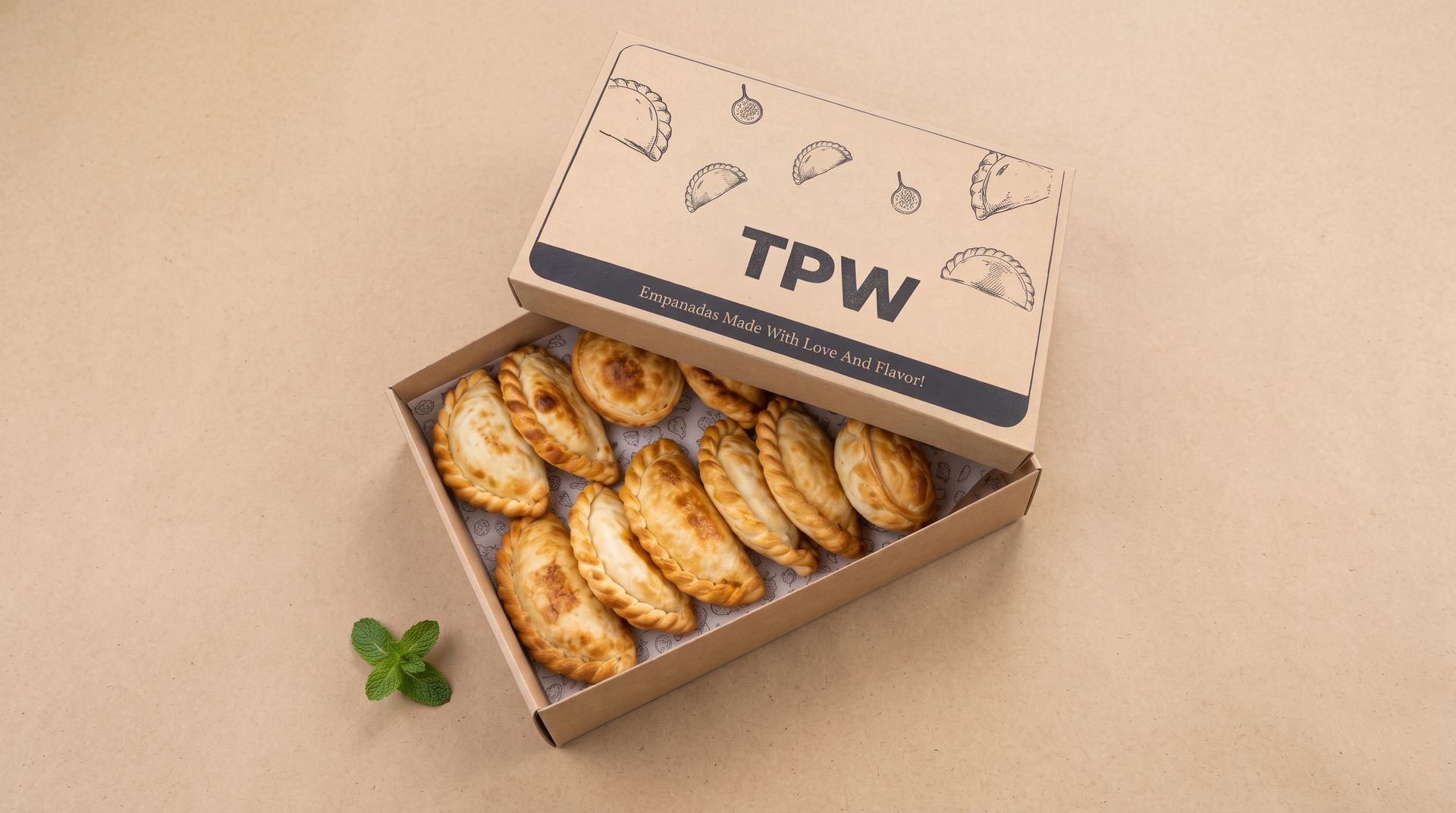
Empanada boxes are printed paperboard cartons and trays that carry warm hand pies from the fryer, oven, or warming case to the counter, the car, or a delivery bag. The right box keeps each empanada upright, protects the crimped seal, and puts the brand on every panel. This guide walks a buyer through who orders them, the box styles available, how to size them, and the mistakes that cost a reorder.
Empanadas are awkward to pack well. They are warm, often a little oily, and the crimped edge cracks if the box is too tight or the pieces slide into each other. The format has to hold the shape without crushing it, which is why the carton is chosen around the empanada and the count, not pulled off a single shelf size.
Who Orders Empanada Boxes
The buyer set is broad, and the build shifts with the service:
Empanada shops and Latin bakeries: branded dozen and half-dozen cartons that read the same across every counter handoff.
Food trucks and street vendors: compact single and three-count boxes that fill fast at the window during a rush.
Cafes and coffee bars: window cartons and single sleeves for a warm grab-and-go case.
Caterers and event kitchens: trays and bulk cartons that hold two dozen or more for parties and office drops.
Quick-service and fast-casual concepts: standardized takeaway cartons sized to the menu empanada.
Frozen and retail empanada brands: printed cartons that hold a sealed inner tray or bag on a grocery shelf.
Ghost kitchens and delivery-first brands: closed cartons with a liner that survive a courier handoff.
Farmers-market and specialty sellers: kraft cartons with a casual, handmade look for weekend stalls.
A walk-up window leans toward a fast-filling sleeve or tuck, while a retail seller leans toward a window carton that sells the crust on the shelf. Compare formats on the food boxes page.
Box Styles and Construction Options
Empanada packaging runs across a few core structures, each matched to the count and the service:
Auto-lock bottom bakery carton: a snap-together base that sets up fast at the case and holds a half-dozen or dozen, the everyday workhorse.
Tuck-top folding carton: a closed box with a tuck closure for smaller takeaway counts across the counter.
Window carton: a closed box with a die-cut window that shows the crust for retail and grab-and-go.
Two-piece tray and lid: a base tray with a separate lid for catering counts and mixed fillings.
Single-serve sleeve or wrap: a printed band for one empanada handed off fast at a cart.
Hinged clamshell: a one-piece base and lid that folds shut over a warm order for quick counter service.
Auto-lock and tuck cartons ship flat and set up on the line; trays and clamshells add structure for travel and larger counts. Match the style to how the order leaves the kitchen.
Sizing the Box to the Empanada
Empanada boxes are sized around the footprint and the count, not a fixed standard. A regular empanada runs roughly a 4 to 5 inch half-moon, a large runs nearer 6 inches, and an extra-large runs longer, so the carton seats the pieces without crowding the crimped edges. The depth is set so a lid closes without pressing on the crust.
A box too large lets the pieces slide and knock together; one too tight squashes the crust and cracks the seal. For a dozen carton, internal rows or a divider keep the pieces apart so they do not stick.
Send your empanada dimensions, the count per box, whether the order is baked or fried, your substrate preference, and your target quantity, and we will recommend a size range with the right clearance. Browse other boxes including burger boxes, sushi boxes, or taco boxes.
Materials at a Glance
The board carries the print and meets the grease and heat of the food. Kraft paperboard, commonly in a 14 to 18 pt range, gives a casual look at a lower print cost. Bright white SBS, commonly in a 14 to 24 pt range, carries full-color art and food photography. Coated or greaseproof-lined board adds oil and moisture resistance for fried empanadas, and corrugated suits bulk catering trays. Grease resistance depends on the coating or liner, the oil content, and how long the order sits, so a fried order is matched to a coated board or liner rather than assumed to hold on plain stock. The substrate should be appropriate for the intended food-contact application; confirm food-contact requirements during quoting. See the materials catalog for the full range.
Printing and Branding
Empanada cartons print across every panel, and the format rewards bold, appetizing art. Full-color printing carries photography on SBS and coated board; one- or two-color printing keeps a clean logo on kraft. Matte or gloss lamination keeps the artwork crisp, and a die-cut window shows the crust on a retail shelf. Finishes are chosen for the look rather than required on every box; browse the wider range on the finishes page.
Common Mistakes to Avoid
Sizing to one empanada size: regular, large, and extra-large pieces need different footprints; spec the carton to the actual menu size.
Skipping dividers on multi-counts: empanadas slide and stick in a loose dozen carton; add rows or an insert when the count is high.
Assuming plain board resists grease: uncoated stock may soak through with a fried order; match a coated board or greaseproof liner to the filling.
Choosing photo art on kraft: kraft tends to mute color, so reserve photography for white SBS or coated board.
Forgetting steam release: a sealed box with no vents can soften the crust in transit; add small die-cut vents for warm builds.
Leaving food-contact suitability unconfirmed: verify the coating or liner is food-contact-appropriate for the filling during quoting, not after the run.
Order Custom Empanada Boxes
Tell us your empanada size, count per box, box style, substrate, grease handling need, and target quantity, and we will recommend a spec and quote it. Standard production runs 10 to 14 business days after artwork approval. Reorders on locked artwork may reduce proofing time because the structure and artwork are already approved, but standard production remains 10–14 business days after artwork approval unless otherwise confirmed. Contact The Printing World at sales@theprintingworld.com, or message us on WhatsApp at +16133831487.
Need custom packaging for your product?
Get pricing, samples, and expert advice — no commitment required.