
Custom Essential Oil Boxes: A Complete Guide to Styles & Printing
Custom essential oil boxes do more than hold a bottle on a shelf. This guide walks a buyer through box styles, sizing by dropper bottle and by single versus set, substrate and printing choices, and the common spec mistakes that slow a first order down, so you can spec an essential oil carton with confidence.

Awais M · Custom Packaging Specialist
Awais M helps small and mid-sized brands get custom packaging right — the box style, the material, the print finish, and the order quantity that actually fits the budget.
What a Custom Essential Oil Box Has to Do
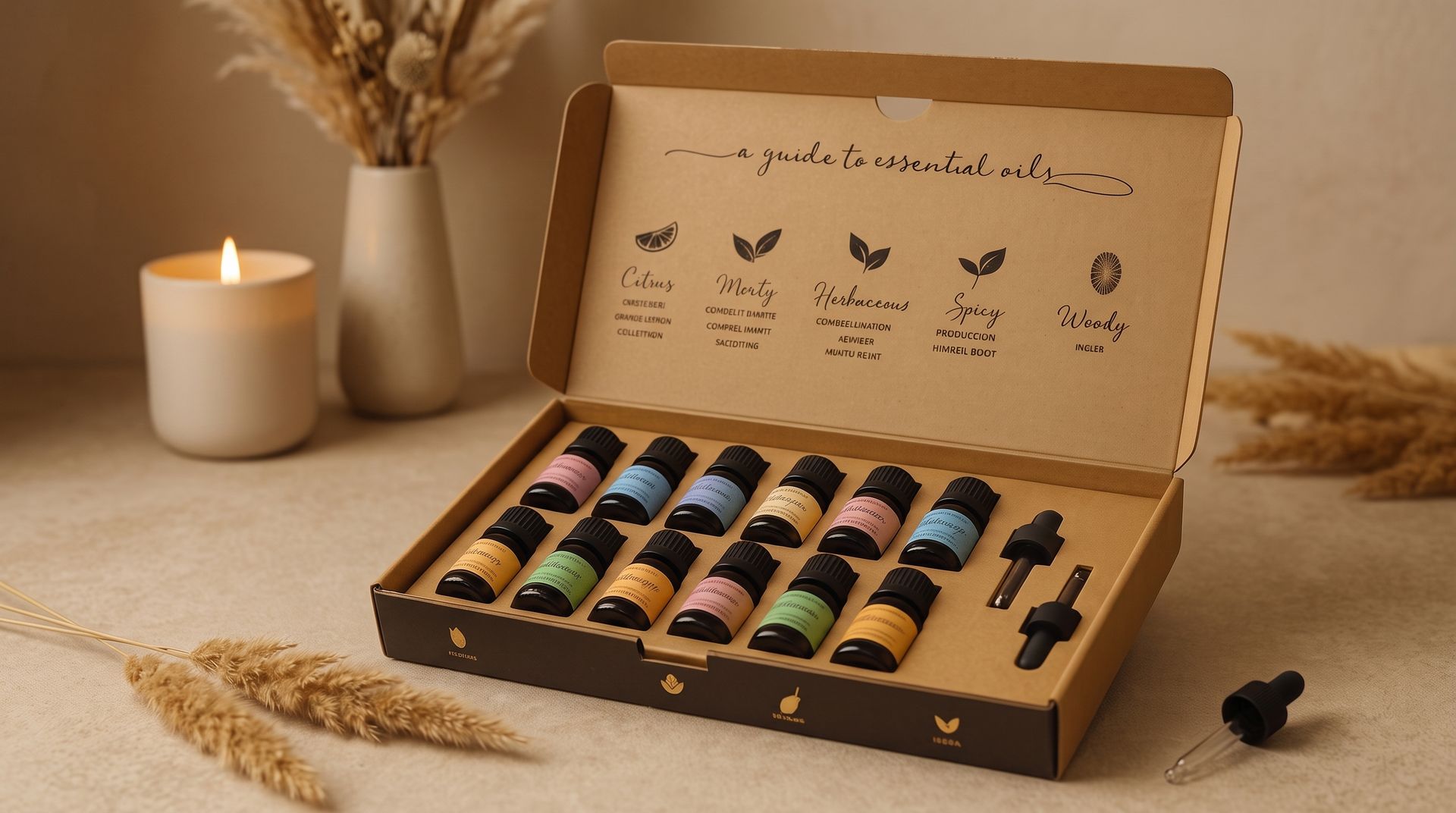
A custom essential oil box is a printed paperboard carton that holds a dropper bottle, a roller bottle, or a multi-bottle set, seats it so it does not shift, and carries the brand, the oil name, and any usage copy across the printed panels. Essential oils sell on scent, source, and the trust a brand builds, so the carton presents the brand on the shelf and protects the bottle on the way there.
The box is secondary packaging, so it presents and protects the bottle rather than touching the oil directly, and the glass bottle stays the barrier for the product. If a tissue or paper wrap is added inside, it should be a suitable paper depending on fragrance, colorant, and product-contact requirements. That keeps the focus where it belongs: a carton built to the bottle, printed to the brand, and priced to the run.
Who Orders Custom Essential Oil Boxes
Essential oil packaging serves a wide buyer set, and the buyer shapes the build.
Aromatherapy lines: cartons that present a single oil or a blend with a clean usage panel.
Wellness and self-care brands: coated cartons that carry full-color art for a retail shelf.
Clean and natural labels: kraft or recycled cartons that match a plant-forward look.
Blend and carrier-oil brands: cartons sized across a range of bottle volumes.
Gift, starter, and sampler sets: divided cartons that seat several bottles together.
Subscription wellness programs: compact cartons that seat one bottle inside a monthly box.
Private-label and white-label fillers: one box program that runs several client oils.
Diffuser and home-fragrance brands: cartons that pair an oil bottle with a card or accessory.
An aromatherapy startup leans toward a kraft folded carton with one strong finish, while a counter wellness brand leans toward a coated carton with a foil-stamped logo. Browse related programs on the cosmetic boxes page.
Box Styles for Essential Oils
Most essential oil boxes run across a folded tier, matched to the bottle and to whether you ship a single bottle or a set.
Tuck-end folding carton: the mid-tier workhorse, light to ship flat and quick to set up for a single oil bottle.
Reverse or straight tuck carton: tuck flaps oriented for easy fill by hand or on a line.
Auto-bottom carton: a locking floor that supports a heavier glass bottle without the base giving way.
Window carton: a die-cut window backed with film so an amber or cobalt bottle reads on the shelf.
Sleeve and tray: a printed sleeve over a tray for a slide-out reveal of a bottle or a set.
Two-piece rigid box: a lid and base on rigid chipboard for a gift or starter set that holds several bottles.
Compare the builds across the custom boxes options and the rigid boxes listing.
Sizing by Bottle and by Single Versus Set
Essential oil box size scales with the bottle, not the milliliter label. A 5ml or 10ml dropper bottle is short and slim, so its box is a small, narrow carton sized to the cap in its closed position, while a 15ml or 30ml bottle needs a taller carton, and a roller bottle runs slim. A 100ml bottle needs a wider, taller box, and a multi-bottle set is sized to the divided insert footprint rather than to one bottle. A slim 10ml dropper and a squat roller bottle need different boxes, so measure the bottle height, diameter, and cap height in the closed position, then add an even clearance so the dropper bulb and orifice reducer seat without forcing.
Materials and Printing
Essential oil cartons are built on SBS for bright full-color art, kraft for an unbleached natural look, recycled paperboard for a sustainability message, or rigid chipboard wrapped in paper for a two-piece gift set. Recyclability depends on the coating, lamination, and any rigid wrap, so a plain folded carton is generally easier to recycle where facilities accept it than a laminated rigid box.
Printing runs CMYK offset or digital for full-color art, with one- or two-color options on kraft. On a tall, narrow oil carton, the front face is slim, so the brand mark, the oil name, the volume, and any usage copy are planned to read down the panel rather than crowding it, and the brand should review usage and ingredient text for the wording it is comfortable standing behind. Finishing options include foil stamping, embossing or debossing, spot UV, and matte or gloss lamination, chosen for the look rather than required on every box. See the materials catalog and the finish options for the full range.
Common Mistakes to Avoid
Sizing to the milliliter label: a 10ml dropper and a roller bottle differ in shape, so measure the bottle, not the volume.
Forgetting the dropper or cap height: an orifice reducer and cap add height; a tight box will not seat, so size to the closed position.
Skipping the insert on a slim bottle: a tall dropper bottle can tip inside a plain carton, so add a paperboard collar or tray when the bottle calls for it.
Letting set bottles knock together: bottles without a divider can contact each other, so use a slotted divider or a die-cut tray for a set.
Treating the box as the barrier: the carton presents and protects the bottle and is not the seal, so confirm any inside wrap against product-contact requirements.
Locking dimensions before the substrate: a rigid wall takes more inside clearance than a thin folded board, so confirm the board first.
Order Custom Essential Oil Boxes
Send your bottle size, single or set count, substrate, print and finishing, and target quantity, and we will recommend a build with the right clearance. Order quantities generally start from around 100 units, and standard production runs 10–14 business days after artwork approval. Reorders on locked artwork may reduce proofing time because the structure and artwork are already approved, but standard production remains 10–14 business days after artwork approval unless otherwise confirmed. Contact The Printing World at sales@theprintingworld.com, or reach us on WhatsApp at +16133831487.
Need custom packaging for your product?
Get pricing, samples, and expert advice — no commitment required.