
Custom Hotdog Boxes: Trays, Clamshells & Cartons Buyer Guide
Hotdog packaging looks simple until you have a chili-cheese dog leaking through a thin tray at a busy window. This guide walks a buyer through who orders custom hotdog boxes, the tray, clamshell and carton styles, the substrate and sizing choices, and the common mistakes that turn up after the first run.

Awais M · Custom Packaging Specialist
Awais M helps small and mid-sized brands get custom packaging right — the box style, the material, the print finish, and the order quantity that actually fits the budget.
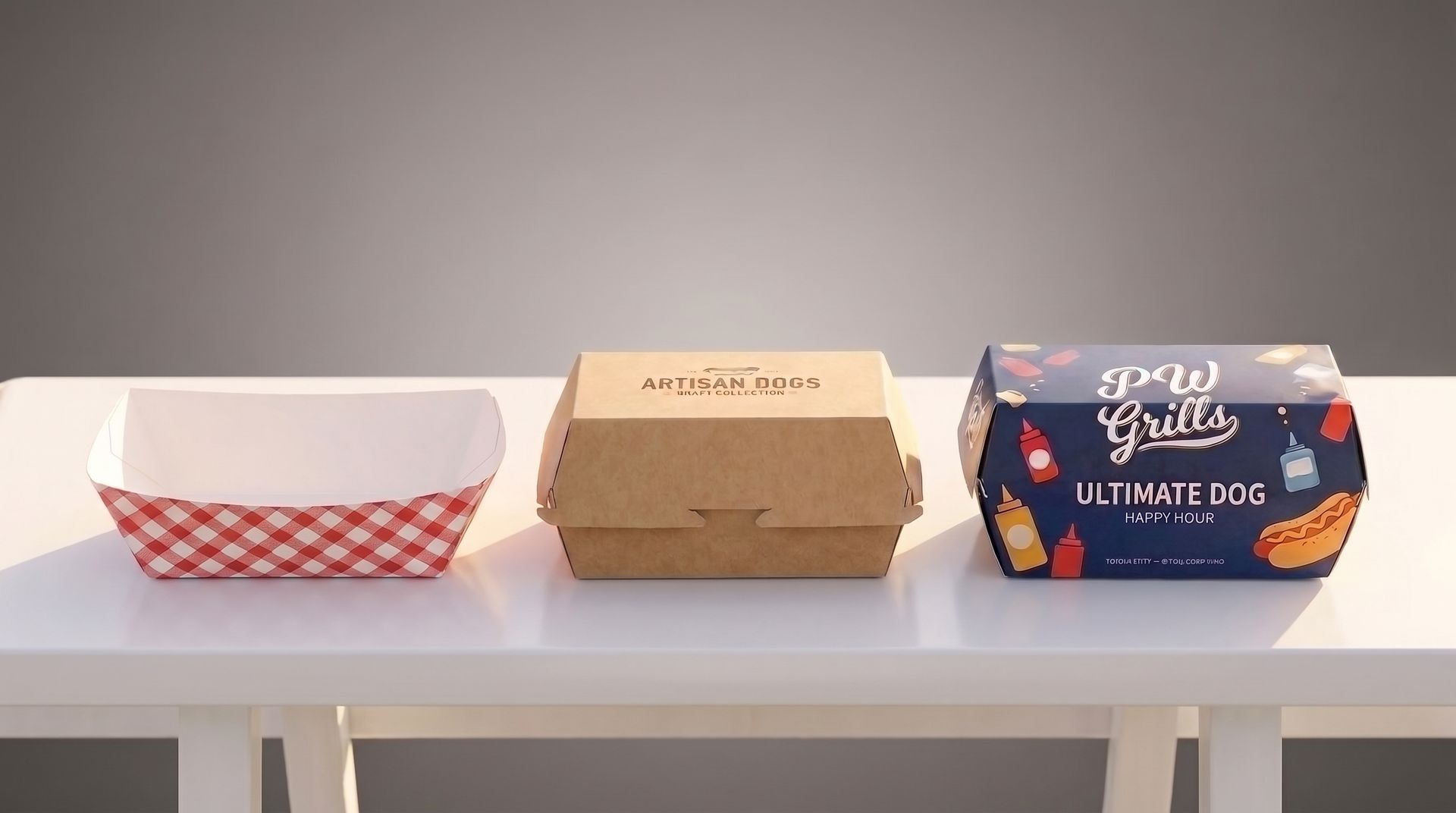
Hotdog packaging looks like a solved problem until a chili-cheese dog soaks through a thin tray at the busiest window of the day. The box has to cradle a soft bun, hold the toppings level, survive the grease and steam, and carry the brand, all while a vendor fills it in a few seconds. This guide walks through hotdog packaging from a buyer's point of view: who orders it, the styles that exist, the materials, how to size it, and the mistakes that surface after the first run.
The right build comes down to two questions. How loaded is the dog, and how far does it travel before someone eats it? A plain mustard dog eaten at the counter and a loaded gourmet dog riding in a delivery bag call for very different structures, even when the menu calls them the same thing.
Who Orders Custom Hotdog Boxes
The buyer set is wide, and each one weighs speed, cost, and presentation differently:
Concession stands and street vendors: want open trays and sleeves that fill fast and hand off in seconds.
Ballparks, stadiums, and arenas: need high-volume trays and combo boxes that move quickly between innings or periods.
Food trucks and festival vendors: want compact builds that stack on a tight prep line.
Quick-service restaurants and hot dog chains: want standardized builds that read the same store to store.
Gourmet and loaded-dog concepts: need deeper clamshells that hold chili, slaw, and toppings without going soft.
Cinemas, bowling alleys, and entertainment venues: want grab-and-go trays for walk-up snack counters.
Ghost kitchens and delivery-first brands: need closed cartons with a liner that survive a courier handoff.
Diners and casual-dining kitchens: want branded trays for dine-in baskets and takeout sides.
Tell us which of these you are, and the build narrows fast. Compare the broader range on the food boxes listing.
Box Styles and Construction Options
Hotdog packaging runs across a handful of core structures, each matched to the dog and the service:
Open serving tray (boat): a low, open-top tray that cradles a single dressed dog for fast counter and walk-up service.
Hinged clamshell: a one-piece base and lid that folds shut over a loaded dog to keep chili, slaw, and relish in place.
Tuck-top carton: a closed folding box with a tuck closure, used when the order travels in a delivery bag and needs a lid.
Footlong tray or sleeve: a longer build sized so the ends of a footlong dog and bun stay supported.
Two-dog or combo box: a wider build that holds two dogs, or a dog with a fries pocket, for combo meal service.
Paper sleeve or wrap: a printed band or open-ended sleeve for a single dog handed off fast at a vendor cart.
Open trays and sleeves ship flat and set up on the line, while clamshells and closed cartons add structure for travel and heavier toppings. Match the structure to your heaviest topping load, not your lightest. See how the formats sit alongside other fast food builds on the sandwich boxes, or burger boxes page.
Materials at a Glance
The board under the print decides how the box handles hot, greasy food. Three substrates cover most hot dog programs:
Kraft paperboard: an unbleached brown board for a casual, street-food look, commonly in a 14 to 18 pt range, best with one- or two-color printing.
SBS (solid bleached sulfate): a bright white board, commonly in a 14 to 24 pt range, that carries full-color art and food photography cleanly.
Coated and greaseproof-lined board: a coating or inner liner that adds oil and moisture resistance for chili-cheese and loaded dogs.
Grease resistance depends on the coating or liner, the sauce and oil content, and how long the dog sits, so a loaded order is matched to a coated board or greaseproof liner rather than assumed to hold on plain stock. The substrate should be appropriate for the intended food-contact application; confirm food-contact requirements during quoting. Browse the full range on the materials catalog.
Printing and Branding
Hotdog trays and cartons print across every panel, and the format rewards bold, appetizing art. Full-color printing carries photography and brand color on SBS or coated board, while one- or two-color printing keeps a clean logo on kraft for a lower cost. Matte or gloss coatings keep the artwork crisp, and small die-cut vent holes release steam so the bun does not go soggy. Finishes are chosen for the look, not required on every box, so keep the treatment in proportion to the run. Coordinate the options on the finsihes page.
Sizing Basics
Hotdog boxes are sized around the dog length and the topping load, not a single standard. A standard dog runs around a 6 to 8 inch bun footprint, a footlong runs roughly double the length, and a two-dog or combo build runs wider. The height is set to the toppings, so a plain dog runs a shallow tray while a loaded dog runs a deeper clamshell with headroom above the bun. Send your bun length and a description of the heaviest topping load, and we will recommend the size range with the right clearance.
Tell us your dog length, your heaviest topping load, whether the order travels or is eaten on site, and your target quantity, and we will spec the build and size it.
Common Mistakes to Avoid
Sizing for the plain dog, not the loaded one: a tray sized to a bare dog crushes the bun once chili and toppings go on; size to the heaviest build on the menu.
Assuming plain board resists grease: uncoated stock may soak through with a sauced dog; match a coated board or greaseproof liner to the topping load.
Choosing an open tray for delivery: an open boat lets toppings shift in a bag; use a clamshell or closed carton when the order travels.
Printing photo art on uncoated kraft: kraft tends to mute color, so reserve photography for white SBS or coated board.
Forgetting steam release: a closed box with no venting can leave the bun soggy; consider small vent holes for hot, closed builds.
Leaving food-contact suitability unconfirmed: verify the coating or liner is food-contact-appropriate for the menu during quoting, not after the run.
Order Custom Hotdog Boxes
Send your dog length, heaviest topping load, tray or clamshell choice, substrate, branding, and target quantity, and we will recommend a spec and quote it. Standard production runs 10 to 14 business days after artwork approval. Reorders on locked artwork may reduce proofing time because the structure and artwork are already approved, but standard production remains 10–14 business days after artwork approval unless otherwise confirmed. Contact The Printing World at sales@theprintingworld.com, or message us on WhatsApp at +16133831487.
Need custom packaging for your product?
Get pricing, samples, and expert advice — no commitment required.