
Custom Nachos Boxes: Styles, Sizes & Greaseproof Materials
Custom nachos boxes have to keep hot chips crisp and the dip contained while carrying your brand from the warmer to the customer. This guide covers who orders printed nacho boxes, the tray and carton styles that fit each service model, how to size the chip and dip portion, and the material, greaseproof, and printing choices.

Awais M · Custom Packaging Specialist
Awais M helps small and mid-sized brands get custom packaging right — the box style, the material, the print finish, and the order quantity that actually fits the budget.
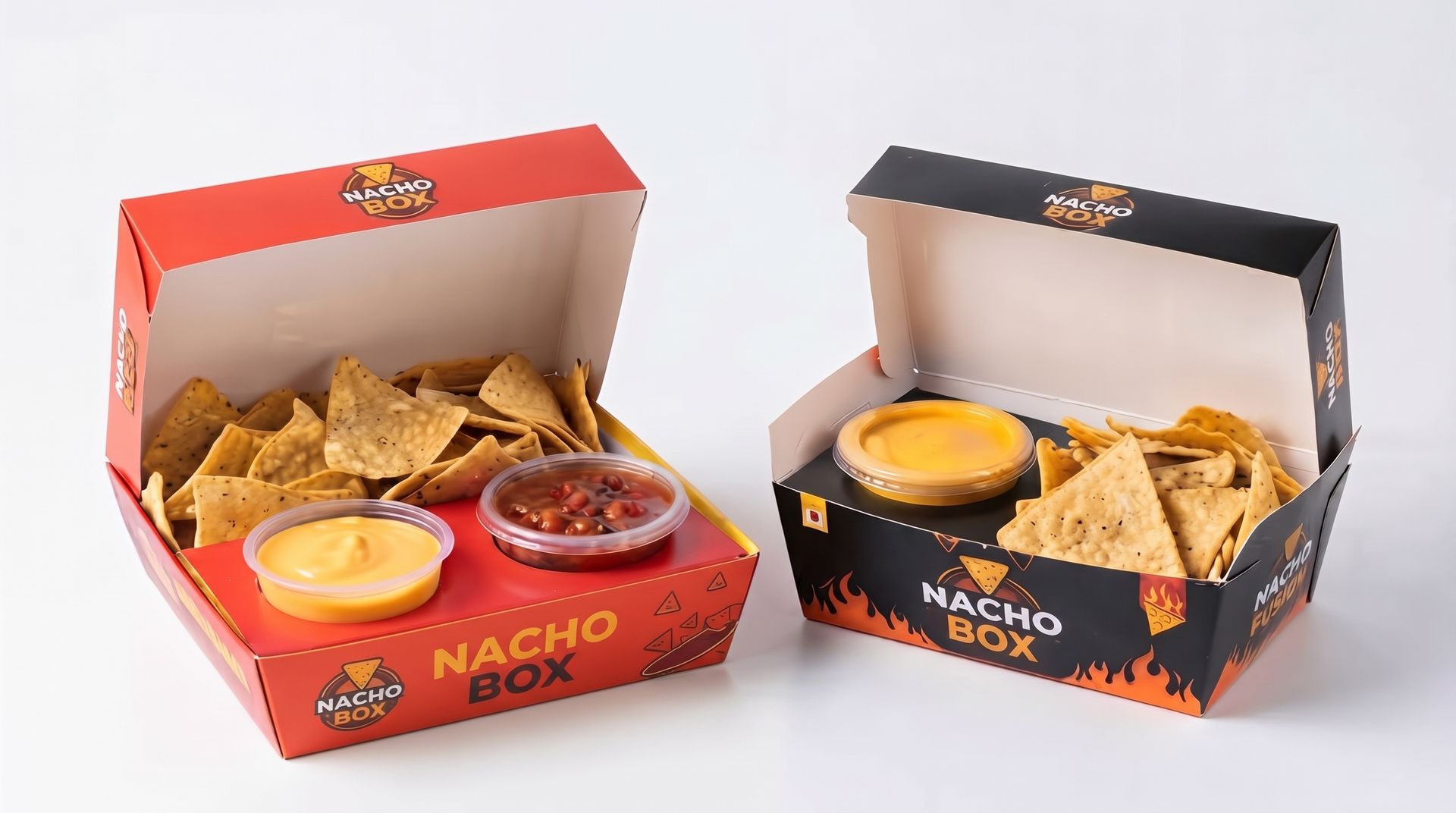
Custom nachos boxes are the tray or cartons that carries one of the fastest-moving snacks in concession and casual food service. Nachos travel hot, they travel oily, and they almost always travel with a dip, so the packaging has to keep the chips upright, hold the cheese or salsa in its own well, and carry the brand at the same time. This guide walks through who orders custom nachos boxes, the styles that fit different service models, how to size the portion, and the material and printing choices that decide how the box performs.
Done right, a printed nacho box does two jobs at once. It keeps the chips crisp and the dip contained from the warmer to the customer, and it puts your logo in the customer's hand for the length of the snack. Done wrong, the chips go soggy, the cheese sloshes into the bag, or the tray buckles under a loaded portion. The difference is mostly in the spec.
Who Orders Custom Nachos Boxes
Nacho packaging is ordered across the whole concession and casual food world, not just one type of operator:
Concession stands: two-compartment trays sized to a standard snack portion for fast counter service.
Cinemas and movie theaters: chip-and-cheese trays that travel from the lobby to the seat without spilling the dip.
Sports venues and stadiums: wide pop-up trays for high-volume snack runs during a game.
Food trucks and street vendors: compact trays and scoop boxes that fill fast at a service window.
Tex-Mex and Mexican quick-service kitchens: printed trays that pair with the rest of the menu across every location.
Fairs, carnivals, and festivals: sturdy trays that hold a loaded portion while customers walk and eat.
Bars, pubs, and casual dining: branded share trays for table-side platters and takeout sides.
Ghost kitchens and delivery brands: closed cartons with a liner that hold the portion through a courier handoff.
If you are comparing printed nacho boxes against plain stock trays, the branded version is what turns a snack order into a brand impression every time the tray hits the table.
Box Styles for Nacho Packaging
Nacho boxes run across a handful of core structures. The right one depends on how the order is served and whether it travels:
Two-compartment tray: the everyday workhorse, an open tray with a large chip well and a smaller dip well that keeps cheese off the chips.
Single open tray: a shallow tray for a dry chips order or when the dip is served in a separate cup.
Three-compartment tray: one chip well and two dip wells for cheese plus salsa or guacamole.
Scoop box: a flat-bottom box with flared sides that holds a deeper portion than a shallow tray.
Tuck-top carton: a closed folding box with a lid for orders that travel in a delivery bag.
Clamshell carton: a hinged base-and-lid build for a loaded portion that needs to be covered.
Stadium pop-up tray: a four-corner pop-up tray that sets up fast and stacks in a warmer.
Open trays and folding cartons ship flat and set up on the line, while clamshells and pop-up trays add structure for transport and display. Browse the full range on the food boxes listing to compare formats side by side.
Choosing the Right Size
Nacho box sizes scale with the chip portion and the dip volume, not a single industry standard. A small two-compartment tray suits a snack portion, often around a 6 by 5 inch footprint, while a wide share tray suits a group, often around an 8 by 6 inch footprint plus clearance for toppings. The dip well is sized to hold enough cheese or salsa to last to the final chip without over-pouring, so the height and well depth are set to the portion and how it is carried.
The goal is chips that stay upright and visible without spilling over the rim, and a dip well deep enough that cheese does not slosh out when the tray moves. A tray too large makes the portion look thin, and one packed too tight crushes the chips and traps steam. Match the footprint to the portion in ounces or grams and the way the box is carried.
Send your chip portion, dip count and volume, serving style (concession, cinema, or delivery), tray or carton preference, and target quantity, and we will recommend the size range and structure.
Materials and Greaseproof Options
Nacho trays are built on a board chosen for look, print quality, and oil exposure:
Kraft paperboard: a casual brown board, commonly in a 14 to 18 pt range, good for one- or two-color printing at a lower cost.
SBS (solid bleached sulfate): a bright white board for full-color, photo-forward art.
Coated or greaseproof-lined board: a coating or inner greaseproof paper liner for hot cheese and loaded portions.
Molded fiber or bagasse: a sustainability-positioned tray with formed compartments, where availability depends on the supplier.
Grease and moisture resistance depend on the coating or liner, the cheese and oil content of the food, and how long the portion sits, so a loaded order is matched to a coated board or greaseproof liner rather than assumed to hold on plain stock. A coated surface may help with light surface protection depending on the coating, liner, cheese content, and contact duration. The substrate should be appropriate for the intended food-contact application, so confirm food-contact requirements during quoting. See the materials catalog for the full substrate range.
Printing and Branding
Nacho boxes print across every panel, and the format rewards bold, appetizing art. Full-color printing carries brand color and food photography on SBS or coated board, while one- or two-color printing keeps a clean logo on kraft at a lower cost. Matte or gloss coatings keep the artwork crisp, and accent finishes such as foil stamping, embossing, or spot UV add a tactile detail where the brand wants one. Finishes are chosen for the look rather than required on every box. Compare the options on the finishes page, and see related formats like sushi boxes, burger boxes, or taco boxes.
Common Mistakes to Avoid
Sizing to the tray instead of the portion: a generic tray can drown a small order or crush a large one, so size to the chip weight and dip volume.
Assuming plain board resists grease: uncoated stock may soak through with hot cheese, so match a coated board or greaseproof liner to the oil exposure.
Using one well when the menu needs two: a single tray lets cheese soak the chips, so consider a two- or three-compartment tray when a dip is served.
Making the dip well too shallow: a shallow well lets cheese slosh out in transit, so set the well depth to the dip volume and how the tray is carried.
Ignoring warmer and bag fit: a tray that will not stack in a warmer or sit flat in a delivery bag creates handling problems, so confirm the footprint.
Treating food-contact suitability as a given: confirm the coating or liner is food-contact-appropriate for the intended use during quoting rather than after the run.
Order Custom Nachos Boxes
Tell us your chip portion, dip count, serving style, tray or carton choice, substrate, grease handling need, branding, and target quantity, and we will spec the box and quote it. Standard production runs 10 to 14 business days after artwork approval. Reorders on locked artwork may reduce proofing time because the structure and artwork are already approved, but standard production remains 10–14 business days after artwork approval unless otherwise confirmed. Contact The Printing World at sales@theprintingworld.com, or message us on WhatsApp at +16133831487.
Need custom packaging for your product?
Get pricing, samples, and expert advice — no commitment required.
Industries