
Custom Spice Boxes: Styles, Sizes & Materials Buyer Guide
Custom spice boxes wrap the jar, tin, shaker, or pouch that holds your seasoning and carry the brand to the shelf. This guide covers who orders spice boxes, the carton and gift-set styles that fit each sales channel, how to size the box to the inner container, and the material and printing choices that decide how the box performs.

Awais M · Custom Packaging Specialist
Awais M helps small and mid-sized brands get custom packaging right — the box style, the material, the print finish, and the order quantity that actually fits the budget.
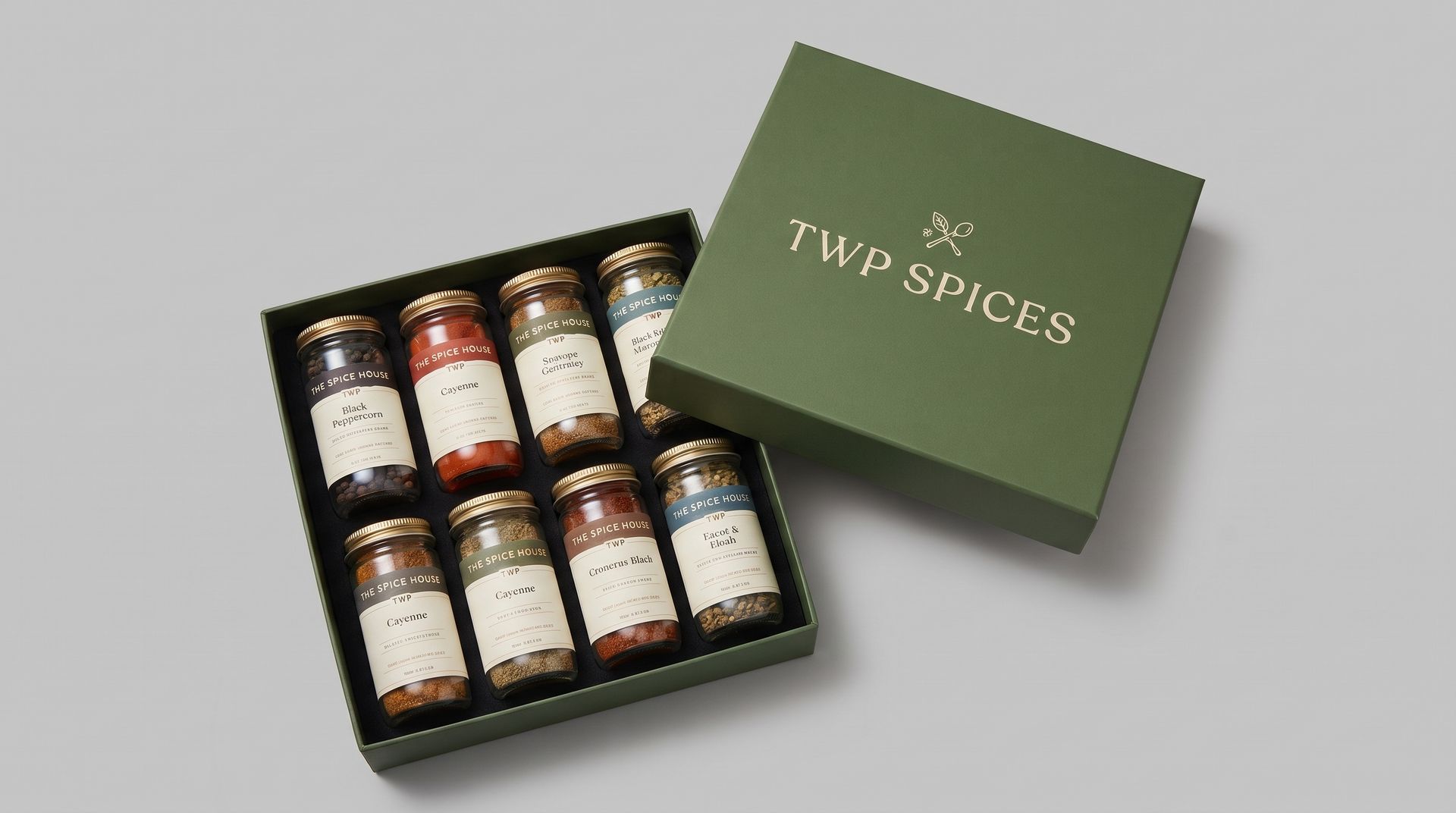
Custom spice boxes are the carton, sleeve, or gift set that carries a retail seasoning product from the production line to the shelf and the home kitchen. In most spice programs the box is secondary packaging: it wraps an inner glass jar, shaker bottle, metal tin, or stand-up pouch that holds the seasoning and provides the seal. The box carries the brand, shields the contents from light and handling, and presents the product where it competes for attention. This guide walks through who orders custom spice boxes, the styles that fit different sales channels, how to size the box to the container, and the material and printing choices that decide how the package performs.
Done right, a printed spice box does two jobs. It protects and frames the inner container, and it puts your brand and blend name in the customer's hand at the shelf and in the kitchen. Done wrong, the carton is loose around the jar, the labeling space is cramped, or a gift set arrives with the jars rattling. The difference is mostly in the spec.
Who Orders Custom Spice Boxes
Spice packaging is ordered across the whole seasoning and specialty-food world, not just one type of brand:
Seasoning and spice brands: printed single-SKU cartons and sleeves that read the same across a full retail line.
BBQ rub and grilling brands: bold cartons and multi-jar sets for steak rubs, chili blends, and smoked paprika seasonings.
Gourmet and artisan blend makers: kraft and recycled cartons that signal a small-batch, natural product.
Tea and specialty grocery shops: branded boxes for in-store blends and house seasonings.
Private-label and contract packers: standardized cartons for store-brand and white-label ranges.
Subscription and direct-to-consumer brands: mailer-friendly boxes and sleeves for spice clubs and online orders.
Gift and corporate-gift sellers: rigid and two-piece sets for curated spice collections.
Farmers market and food-craft vendors: short-run kraft cartons and sleeves for local sales.
Restaurants and chefs with retail lines: branded boxes for house blends sold alongside the menu.
If you are comparing printed spice boxes against plain stock cartons, the branded version is what turns a shelf SKU into a brand the customer recognizes on the next trip. Browse related retail formats on the food boxes listing.
Box Styles for Spice Packaging
Spice boxes run across a handful of core structures. The right one depends on the inner container and how the product sells:
Straight tuck-end carton: the everyday workhorse for a single jar, tin, or shaker, with a clean front face.
Reverse tuck-end carton: an economical folding carton for high-volume single-SKU runs.
Sleeve: an open-ended band that wraps a jar or a clustered pouch, low on material and quick to apply.
Two-piece box (base and lid): a lift-off lid build for a single upscale jar or a small set, with room for an insert.
Drawer (slider) box: a sleeve-and-tray build that slides open, used for gift-positioned jars.
Multi-jar set carton: a partitioned box that holds two, three, or six jars upright for a blend collection.
Rigid gift box: a sturdy wrapped-board build for curated collections and corporate gifts.
E-flute corrugated shipper: a light corrugated mailer for direct-to-consumer orders and multi-unit shipments.
Tuck-end cartons, sleeves, and set boxes ship flat and set up on the line, while rigid and drawer builds add structure and presentation for gift contexts. Compare the structures on the tuck end boxes listing.
Choosing the Right Size
Spice box sizes scale with the inner container and the count per box, not a single industry standard. A single 2- to 4-ounce round or square jar runs a compact tuck-end carton sized to the jar diameter and height plus a little clearance, while a tall shaker bottle runs a deeper carton. A spice tin, often in a 1 to 6 ounce range, runs a shallower footprint, and a stand-up pouch runs a flatter carton or sleeve sized to the filled pouch.
The goal is a container that sits snug so it does not rattle or tip, without forcing the board so tight that filling slows on the line. For multi-jar sets, the box is sized to the jar count with partitions or an insert that keeps each jar upright and separated. Match the footprint to your container dimensions or a physical sample, and to the way the box ships and sells.
Send your container type and size, count per box, box style, substrate, and target quantity, and we will recommend the size range and structure.
Materials and Branding
Spice cartons are built on a board chosen for look, print quality, and channel. Because the inner jar, tin, or pouch provides the seal, the board is selected mainly for branding, light protection, and structure:
Kraft paperboard: a natural brown board, commonly in a 14 to 18 pt range, good for one- or two-color printing at a lower cost.
SBS (solid bleached sulfate): a bright white board for full-color, photo-forward art.
Recycled paperboard: a recycled-fiber option for an eco-positioned line, where availability depends on the supplier.
Rigid chipboard: a thick wrapped board for two-piece and gift-set boxes that need a sturdier feel.
E-flute corrugated: a light corrugated board for multi-jar sets and shippers that add transit protection.
An opaque carton shields the seasoning from light while it sits on a shelf, which can help the inner container do its job. Moisture and aroma retention depend on the inner jar, tin, or pouch and its seal rather than the outer box, so the box is positioned as the branding and protection layer. Spice cartons also print across every panel, so full-color art carries brand color and blend photography on SBS, while one- or two-color printing keeps a clean logo on kraft. Matte or gloss lamination protects the print, and accent finishes such as foil stamping, embossing, or spot UV add a tactile detail where a gift set calls for one. See the material catalog and compare finishes on the finishes page.
Common Mistakes to Avoid
Sizing the box to a guess instead of the container: a loose carton lets the jar rattle and tip, so size to your actual jar, tin, or shaker dimensions or a physical sample.
Expecting the box to seal the spice: the inner container holds the aroma and moisture seal, so do not rely on the carton alone for freshness.
Cramping the labeling space: ingredient lists, net weight, and blend names need room, so plan panel layout before locking the die.
Skipping partitions on a multi-jar set: jars without an insert knock together in transit, so add partitions or a tray when the box holds more than one.
Choosing rigid for a mass-market shelf SKU: rigid suits gift sets, while a tuck-end carton is the everyday workhorse for single retail units.
Filling loose spice into a plain carton: a direct-fill box needs a food-contact-appropriate inner liner or pouch, so confirm food-contact requirements during quoting rather than after the run.
Order Custom Spice Boxes
Tell us your container type and size, count per box, box style, substrate, branding, finishing, and target quantity, and we will spec the box and quote it. Standard production runs 10 to 14 business days after artwork approval. Reorders on locked artwork may reduce proofing time because the structure and artwork are already approved, but standard production remains 10–14 business days after artwork approval unless otherwise confirmed. Contact The Printing World at sales@theprintingworld.com, or message us on WhatsApp at +16133831487.
Need custom packaging for your product?
Get pricing, samples, and expert advice — no commitment required.