
Mushroom Box Sizes: Tills, Punnets, Trays & Grow-Kit Cartons
Mushroom box sizes are driven by pack weight and variety, not a single industry standard. This guide walks through retail till and punnet weights, bulk corrugated tray volumes, handled market boxes, and grow-kit cartons sized to the substrate block, with the clearance and handling notes that keep a pack from crushing or tumbling on the way to market.

Awais M · Custom Packaging Specialist
Awais M helps small and mid-sized brands get custom packaging right — the box style, the material, the print finish, and the order quantity that actually fits the budget.
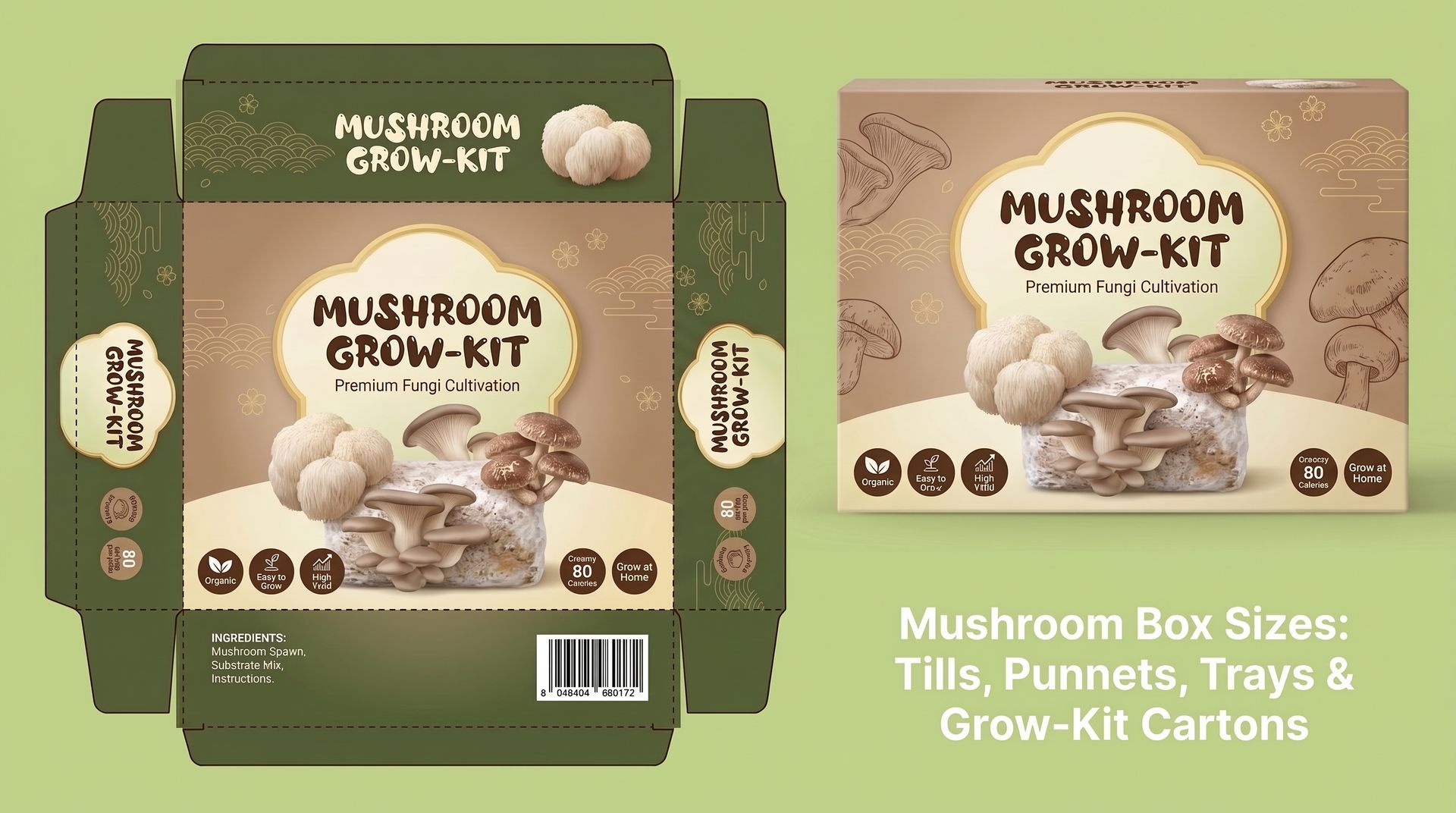
Mushroom box sizes confuse a lot of first-time buyers because there is no single standard. A retail till, a wholesale tray, and a grow-kit carton are sized in completely different ways — one by pack weight, one by volume, and one by the substrate block inside. This guide walks through the common formats and how each one is sized, so the pack matches the harvest and the channel.
The right size keeps the caps intact and the pack looking full without crushing delicate gills. Get the footprint wrong, and the mushrooms either tumble loose and bruise or sit crammed under a lid. Size to the pack weight and the variety first, then to the shelf or shipping footprint.
Who Orders by Size
Different buyers gravitate to different size bands:
Gourmet growers: small retail tills and clamshells for high-value specialty varieties.
Grocery and produce retailers: standard till weights sized to a shelf facing.
Farmers-market growers: handled market boxes and mid-size punnets.
Wholesale and foodservice: bulk corrugated trays measured in pounds.
Grow-kit brands: cartons sized to the substrate block, not a pack weight.
CSA programs: compact tills that fit a shared produce box.
Dried-mushroom sellers: small folding cartons sized to a sealed inner pouch.
Send your variety and channel, and we will point you to the right size band. Compare formats on the food boxes listing.
Box Styles and Construction Options Behind the Sizes
Size always follows the format, so it helps to know which build you are sizing before you pick a weight:
Vented till or punnet: sized by retail pack weight for fresh shelf packs.
Hinged clamshell: sized to the pack weight with headroom for the caps under the lid.
Kraft handled market box: sized to a fuller farm-stand pack with room for a handle.
Corrugated master tray: sized by bulk weight in pounds and by stack height.
Grow-kit carton: sized to the substrate block, not a pack weight.
Window carton: sized to a sealed inner pouch for dried or specialty mushrooms.
See the substrate options that pair with each build on the materials catalog, and browse related produce formats: sandwich boxes, or sushi boxes.
Retail Till and Punnet Sizes
Fresh retail packs are sized by pack weight rather than fixed dimensions, since cap size varies by variety:
8 oz (about 227 g) till: 5.0" x 4.0" x 3.0" - a common small retail facing for sliced or whole button, cremini, and specialty packs.
16 oz (about 454 g) till: 7.25" x 5.25" x 3.5"- a mid-size family pack for everyday varieties.
24 oz till: 8.5" x 6.5" x 4.0"- a larger value or club pack.
250 g punnet: 5.5" x 4.25" x 2.75" - a common metric retail weight for specialty and exotic varieties.
500 g punnet: 7.5" x 5.5" x 3.25" - a mid-size metric pack for higher-volume varieties.
These are planning weights, not exact dimensions — a delicate oyster cluster fills a larger footprint per ounce than a dense button pack, so the till depth and width are set to the variety plus clearance. Send your variety and pack weight, and we will recommend a size around that weight plus the clearance the caps need.
Bulk and Wholesale Tray Sizes
Wholesale and foodservice packs move volume, so they are sized by weight in pounds and by stacking strength:
2 lb tray: 10.0" x 8.0" x 3.0" - a small master tray for restaurant or distributor orders.
3 lb and 5 lb trays: 12.0" x 9.0" x 3.5" - common mid-volume bulk formats.
10 lb box: 16.0" x 12.0" x 7.5" - a larger corrugated case for high-volume transport.
Bulk formats use corrugated board (commonly C or B flute) so they stack without crushing the lower layers, and the flute is matched to the stack height and the ship distance. Tell us your bulk weight per box, how high the boxes stack on a pallet, and the ship distance, and we will recommend a corrugated spec.
Grow-Kit Carton Sizes
Grow-kit cartons are sized to the substrate block or bag, not a pack weight. The carton is built so the block seats snugly with room for any instruction insert, and a die-cut fruiting window or vent is positioned where the customer opens the block as the instructions direct. Heavier blocks call for a sturdier corrugated flute and a carton sized so the block does not shift in transit. Send your block dimensions and weight, and we will size the carton around it. See related material choices on the materials catalog.
Standard Block Grow-Kit Carton (3 lb to 4 lb Substrate): 6.5" x 6.5" x 10.0"
The industry standard height for oyster, lion's mane, and shiitake block kits.
Large / Jumbo Grow-Kit Carton (5 lb to 6 lb Substrate): 8.0" x 8.0" x 12.0"
Built for heavy yield commercial home-grow systems requiring additional air headspace.
Common Mistakes to Avoid
Assuming a fixed dimension per weight: cap size varies by variety, so size around the pack weight plus clearance rather than a single dimension.
Oversizing a delicate pack: too much room lets fragile caps tumble and bruise; keep the footprint snug with light clearance.
Undersizing a full pack: cramming mushrooms under a lid crushes gills; leave headroom for the caps.
Ignoring stack height on bulk trays: a flute that is too light buckles under a tall pallet; match corrugated to the stack and ship distance.
Sizing a grow-kit carton to a weight: size it to the substrate block dimensions, not a produce pack weight.
Forgetting the shelf or rack footprint: a till that does not seat in a standard produce rack creates handling problems; confirm the facing during quoting.
Order Mushroom Boxes in the Right Size
Tell us your variety, pack weight or block dimensions, channel, and how the boxes stack or ship, and we will recommend a size range and quote it. Standard production runs 10 to 14 business days after artwork approval. Reorders on locked artwork may reduce proofing time because the structure and artwork are already approved, but standard production remains 10–14 business days after artwork approval unless otherwise confirmed. Contact The Printing World at sales@theprintingworld.com, or message us on WhatsApp at +16133831487.
Need custom packaging for your product?
Get pricing, samples, and expert advice — no commitment required.