
Custom Baguette Packaging: How to Choose the Right Box
A baguette is long, narrow, and crusty, so the box has to fit the loaf and breathe the right amount. This guide walks a first-time buyer through custom baguette packaging, from length and construction to material, venting, and finishing, with the spec questions that get you an accurate quote.

Awais M · Custom Packaging Specialist
Awais M helps small and mid-sized brands get custom packaging right — the box style, the material, the print finish, and the order quantity that actually fits the budget.
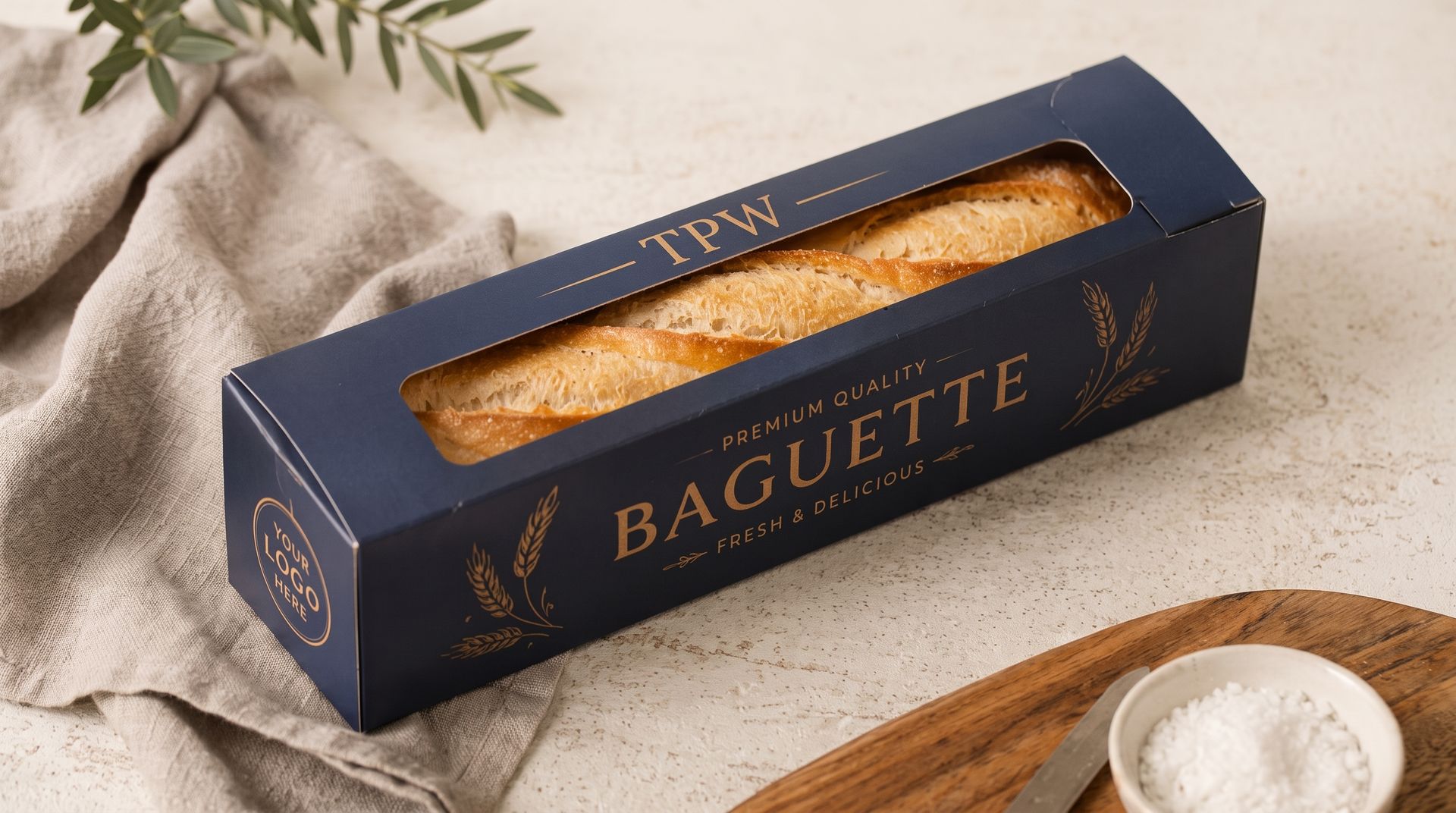
Choosing Custom Baguette Packaging That Holds the Loaf
A baguette is an awkward thing to package. It is long, it is narrow, the crust is the product, and most loaves are sold and eaten the same day. Get the box wrong, and you either crush the ends in transit or trap steam and soften the crust before the buyer gets home. This guide walks a first-time buyer through the decisions that matter for custom baguette packaging, from length and construction to material, venting, and finishing.
The aim is a box that fits the loaf you actually bake, breathes the right amount for how the bread is sold, and carries your brand cleanly. For the construction and sizes behind these choices, the custom baguette boxes product page covers the full range.
Who Orders Custom Baguette Boxes
Baguette packaging is bought across a few kinds of programs, and each starts the spec from a different place:
Artisan bakeries and boulangeries running kraft sleeves that show the crust on same-day loaves
Supermarket and in-store bakery programs standardizing a windowed long carton across stores
Sandwich shops and delis packing filled baguette subs in enclosed cartons with a liner
Cafes and grab-and-go counters using a sleeve or short carton for demi-baguettes
Farmers-market and craft bakers choosing unbleached kraft for a handmade look
Caterers and event bakers ordering multi-loaf cartons for bulk service
Knowing which of these you are buying for sets the length, the venting, and the print before anything else.
Box Styles and Construction Options
Four constructions cover most baguette programs, and the right one follows how the bread is sold and how long it sits:
Open-ended kraft sleeve: a band around the middle of the loaf with both ends exposed, so a warm loaf can release steam and the crust stays crisp. The lightest, most artisan option for same-day loaves.
Full-length tuck-end carton: an enclosed long box that covers the whole loaf, protects it in transit, and stacks better than a sleeve. A vent cut can help an unfilled loaf breathe inside a closed box.
Long window carton: a die-cut window down the panel that shows the crust color and score marks in a self-serve case.
Two-piece or auto-bottom sandwich box: a base-and-lid or formed-base build that carries the weight of a filled sub and keeps the box square, usually with a greaseproof liner.
Browse related constructions on the bakery boxes category listing.
Material and Finishing Basics
Three substrates cover most baguette boxes. Kraft paperboard gives an unbleached natural look and is the common default for bread sleeves and cartons. SBS coated paperboard gives a bright white surface for color-forward retail cartons. Corrugated board suits multi-loaf and catering quantities where a long folding carton would flex under the span.
The exterior is not always what touches the bread. A paper band, a parchment sheet, or a glassine liner often sits between the loaf and the board, especially for filled sandwiches. Where the bread or a filling contacts the interior, the substrate and any liner can be specified to be food-contact-appropriate for that use. Finishing is optional and includes matte or gloss lamination, aqueous coating, spot UV, and foil stamping. The finishes catalog page covers the full set.
Venting and the Crust
Bread is the one bakery product where airflow is part of the spec. A warm loaf gives off steam, and a fully closed box can trap that steam and soften the crust. An open-ended sleeve, a vent cut, or a perforated panel can help release moisture so the crust holds, while a dry loaf left fully open can stale faster. The right balance depends on the bread and the hold time, so confirm the venting approach against how the loaf is baked and sold rather than copying another product's box.
Common Mistakes to Avoid
Sizing to a square footprint: a baguette is defined by length. Size the box to the loaf length and diameter, not a generic carton.
Sealing a warm loaf fully shut: trapped steam softens the crust. Add a sleeve, vent cut, or perforation for same-day loaves.
Skipping a liner on a filled sub: butter and oily fillings contact the board. Add a greaseproof liner for sandwich baguettes.
Using light folding stock for multi-loaf cartons: a long carton bows under several loaves. Step up to corrugated for catering quantities.
Assuming any board resists grease: resistance depends on coating, recipe, and contact time. Confirm the interior against your product.
Ordering before the loaf length is fixed: a few inches changes the die. Lock the loaf length before tooling.
MOQ, Lead Time, and Reorders
Minimum order quantity starts at 100 units per SKU on standard formats, with custom dies quoted per project. Pricing moves with the board, the construction, any liner, and any window or finishing. Standard production runs 10-14 business days after artwork approval, which our team confirms once the spec is locked. Reorders on locked artwork may reduce proofing time because the structure and artwork are already approved, but standard production remains 10-14 business days after artwork approval unless otherwise confirmed. For where baguette boxes fit a wider menu, see the food and beverage packaging industry page.
Order Custom Baguette Boxes
Share the loaf length and diameter, whether the baguette is plain or filled, the construction you want, the substrate, whether you need a liner or window, and your target quantity. Reach The Printing World at sales@theprintingworld.com, or message +16133831487, and our team will review the details and provide a quote and proofing guidance once the specifications are confirmed.
Need custom packaging for your product?
Get pricing, samples, and expert advice — no commitment required.