
Custom Baklava Boxes: A Buyer Guide to Styles, Sizes & Printing
Baklava is rich, sticky, and easy to crush, so the box has to do real work. This guide walks through the box styles, sizes, materials, and printing choices that go into a custom baklava box, and the questions a bakery should answer before ordering a first run.

Awais M · Custom Packaging Specialist
Awais M helps small and mid-sized brands get custom packaging right — the box style, the material, the print finish, and the order quantity that actually fits the budget.
Why Baklava Needs a Box Built for It
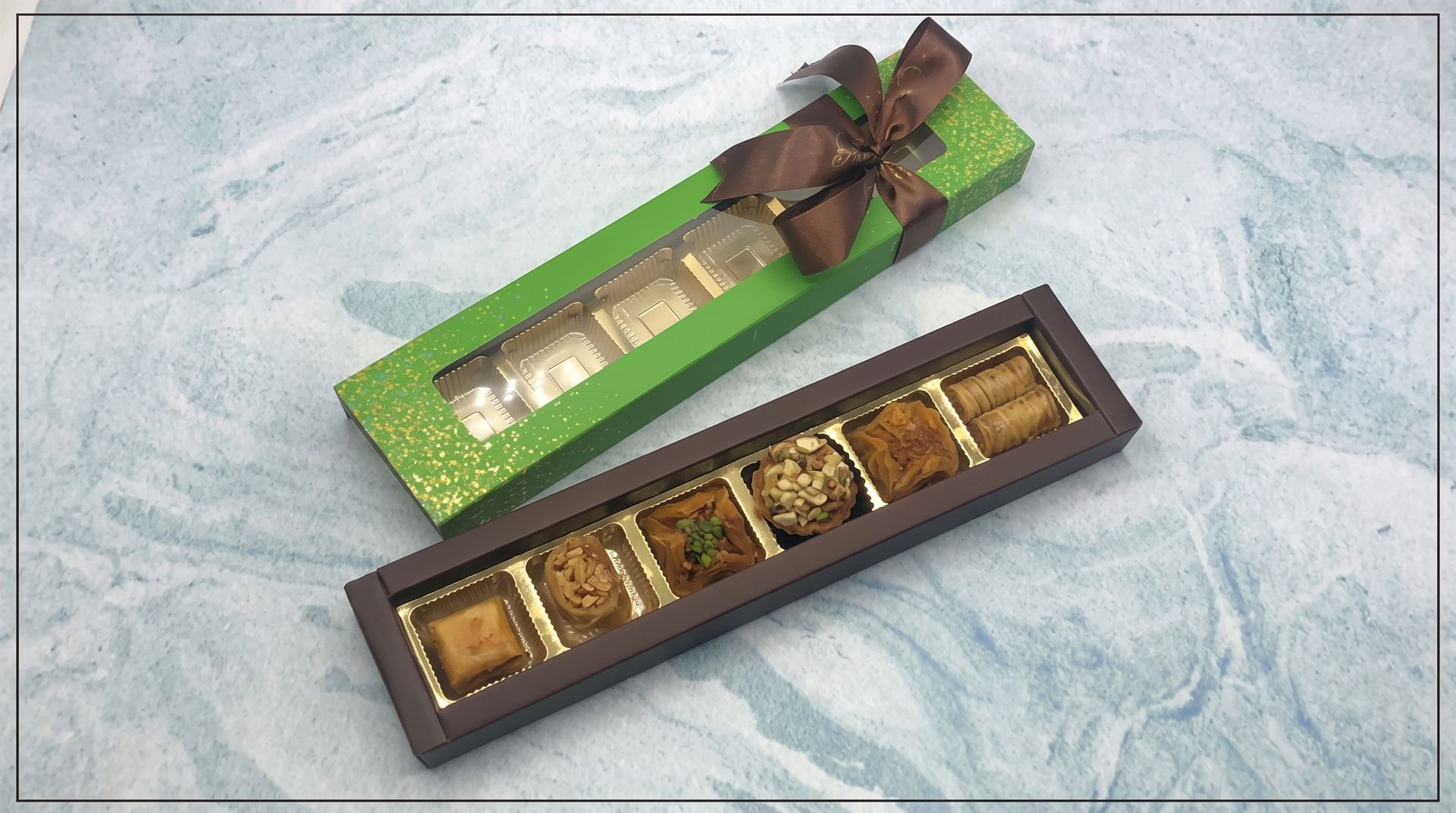
Baklava is one of the harder sweets to package well. The pieces are layered phyllo soaked in syrup, heavy for their size, and quick to crush or stick together if they shift in transit. A box that works for a dry snack will let diamond-cut and finger pieces slide into one block and smear syrup across the panels. A custom baklava box is shaped around those realities: it seats the pieces firmly, manages the syrup and oil the layers carry, and presents the shop's brand from the counter to the customer's table.
This guide walks through the choices that go into a baklava box so a bakery or sweet shop can order a first run with confidence. We cover who buys these boxes, the main construction styles, how to size the carton to the order, the materials and food-contact considerations, and the printing options that make the box look the part. For the full product page, see custom baklava boxes.
Who Orders Baklava Boxes
The buyer set for baklava packaging is broader than a single bakery type. Common buyers include:
Mediterranean and Middle Eastern bakeries carrying a signature assortment home for customers
Turkish and Greek sweet shops selling the core product in set piece counts and weights
Dessert caterers supplying weddings, banquets, and holiday spreads
Gift and corporate programs sending mixed-selection boxes for Eid, Ramadan, and seasonal gifting
Specialty grocers and delis stocking shelf-ready boxes in an ambient or chilled case
Online dessert brands shipping a delicate assortment through carrier handling
Restaurants and cafes boxing a dessert order for takeaway
The program shapes the box. A retail shop leans toward a window box that previews the pieces, a caterer leans toward larger assortment boxes, and a gift brand leans toward a two-piece or rigid box that presents a mixed selection. Browse the food packaging industry page for how these formats fit a dessert menu.
Box Styles for Baklava
Baklava boxes run across a few core builds, each tied to the piece count, the weight, and how the order is shown:
Tray-and-sleeve box: an inner tray that seats the pieces with an outer sliding sleeve for branding, a clean retail and gift format
Two-piece lid and base: a separate lid over a base, a tidy presentation for gift assortments and heavier boxes
Window display box: a carton with a die-cut window, open or film-backed, that previews the pieces in a case
Tuck-end carton: a simple fold-in closure for smaller few-piece and grab-and-go boxes
Rigid gift box: a set-up rigid box for celebration and corporate gifting where presentation matters
Mailer-style carton: a sturdier outer box for online orders that travel by carrier
Folded cartons ship and store flat before they are set up and filled, which keeps freight compact, while rigid boxes arrive set up and lean toward gift use. Compare related builds on the Bakery Boxes category listing.
Sizing the Box to the Order
Baklava is usually sold by weight and by piece count, so the box size follows the order rather than a single standard. A small box runs a compact footprint sized to a few pieces plus a little clearance, a half-kilo box runs a wider tray that seats a shareable assortment, and a full kilo gift box runs a larger footprint for a mixed selection. A divider or insert keeps the pieces seated so they do not slide into one another.
The right size keeps the pieces flat and the syrup off the panels. A box too large lets the pieces shift, and the corners catch, while one packed past capacity presses the layers together and crushes the phyllo. Send your piece dimensions and the counts or weights you sell during quoting so the footprint fits the order with the right clearance.
Materials and Food Contact
Baklava cartons are built on a board chosen for the print look and the order weight. Bright white SBS prints full-color art cleanly, natural kraft gives an artisan look at a lower print cost, coated paperboard keeps illustrations crisp, and rigid board suits gift and celebration boxes. Caliper and construction follow the weight, so a kilo assortment is matched to a sturdier board while a few-piece box can run lighter.
Because baklava sits in syrup and carries oil, the interior that touches the pieces matters. The substrate is food-contact-appropriate depending on the liner or tray choice, so a syrup-heavy assortment is matched to the right inner barrier rather than assumed. Many programs seat the pieces in a coated tray or paper liner that keeps the syrup off the print board. Grease and moisture handling vary by the coating, liner, recipe, and contact time, so confirm your food-contact requirements during quoting. For the substrate range, see the packaging materials catalog.
Printing and Finishing
Baklava boxes print across every panel, and the format rewards warm, appetizing art and ornamental pattern work that suits Mediterranean and Middle Eastern branding. Full-color printing carries brand color and photography, one- or two-color printing suits a clean logo on kraft, and pattern art frames the box with geometric borders. Finishes are chosen for the look rather than required on every box: matte or gloss lamination sets the surface, foil stamping adds a metallic mark for gift boxes, and embossing or spot UV adds tactile contrast. For the wider range, browse the finishing options.
Common Mistakes to Avoid
Skipping the liner or tray: syrup smears across an unlined board. Seat the pieces in a coated tray or paper liner matched to the recipe.
One size for every order: a single carton rarely fits both a few pieces and a kilo assortment. Run a small size mix matched to your weights.
Too little clearance: a tight footprint crushes the phyllo edges. Size around the pieces plus a little clearance.
A light closure on a heavy box: a tuck-end can pop under a kilo assortment. Choose a two-piece base or rigid build for the heaviest sizes.
An open window for a sticky assortment: an open cutout exposes the pieces. Use a film-backed window where the pieces benefit from a barrier.
No room for required text: plan panel space for the weight, assortment name, and any allergen or ingredient text alongside the brand art.
Order Custom Baklava Boxes
Send your piece count or box weight, piece dimensions, divider and tray needs, window choice, substrate, and target quantity to The Printing World. Our team will review the details and provide a quote and proofing guidance once the specifications are confirmed. Reach us through sales@theprintingworld.com, or +16133831487.
Standard production runs 10–14 business days after artwork approval, with rigid builds and specialty dies reviewed against that window when the spec is locked. Reorders on locked artwork may reduce proofing time because the structure and artwork are already approved, but standard production remains 10–14 business days after artwork approval unless otherwise confirmed.
Need custom packaging for your product?
Get pricing, samples, and expert advice — no commitment required.