
How to Design a Cartoon Cereal Boxes: Mascot Art, Construction & Print
A cartoon cereal box sells with its character, so the design starts with the mascot and the carton is built to carry it. This guide walks the mascot art, carton construction, sizing, printing, and finishing so you can hand a printer a clean brief for an illustrated cereal box.

Awais M · Custom Packaging Specialist
Awais M helps small and mid-sized brands get custom packaging right — the box style, the material, the print finish, and the order quantity that actually fits the budget.
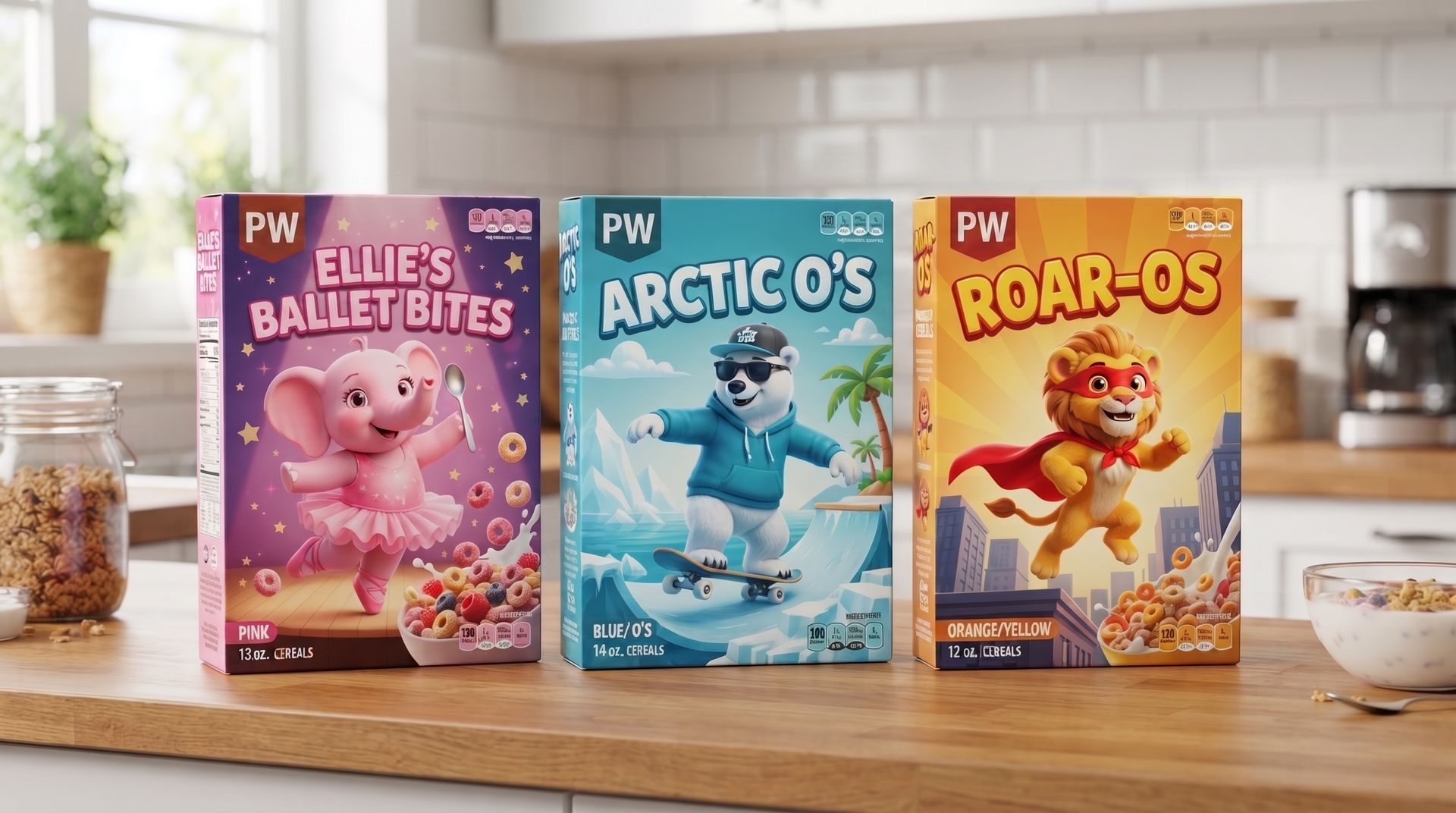
Start With the Mascots of Cereal Boxes
A cartoon cereal box sells with its character. A shopper or a kid recognizes the mascot on the front panel before they read the name, so the design work starts with the character art and the box is built to carry it. Get the mascot right, and the carton becomes a frame; get the carton wrong, and even a strong character prints muddy or sits crooked on a shelf.
The construction logic is simple. The outer carton is a printed paperboard shell that holds your mascot artwork and panel copy, and the cereal sits inside a sealed inner liner pouch that is the food-contact layer. The printed box is secondary packaging wrapped around that sealed inner bag, so the food-contact requirement stays on the liner, not the board. That split is the first thing to understand when you brief a custom cereal box.
This guide walks the mascot art, the carton construction, sizing, printing, and finishing, so you can hand a clean brief to a printer and get an illustrated cereal box that reads as one character family across every flavor.
Construction Options
Most cartoon cereal packaging is a folding paperboard carton delivered flat, so it folds up on a manual or automated line. A few builds cover almost every character cereal program:
Tuck-end folding carton: the familiar upright cereal box with a tuck flap top, giving the largest flat front panel for the mascot
Auto-bottom carton: a self-locking base for heavier fills or taller boxes that need a sturdier bottom on a fast line
Die-cut window carton: a shaped window that frames the cereal, or a die-cut around the mascot silhouette for a novelty cereal box cue on shelf
Single-serve and party-favor carton: a small upright box for multipacks, sample drops, and event tables that still carries the full character art
The window is worth a thought for a kids cereal box with a mascot: a die-cut around the character outline turns the box itself into a shelf cue, while a clear panel shows the cereal. Either adds a die-cutting step, so confirm it early. See the box styles guide for how each build folds.
Cartoon Cereal Box Sizes
Cereal boxes are sized by fill volume plus headspace clearance, so the cereal is not crushed and the front panel stays flat for the character. Most programs land on a few familiar footprints: a family size around 12 in tall by 7 in wide by 2.5 in deep that gives the mascot the most room, a standard retail size around 9 in tall by 7 in wide by 2.5 in deep for the grocery shelf, and a mini or single-serve around 6 in tall by 2 in wide by 1.5 in deep for multipacks and party favors.
These are common planning formats, since cereal density varies between a light flake and a dense cluster. The cleanest way to size a box is to share the target fill weight or volume and the cereal type, and the carton and liner are sized around that with the right clearance. You can print on standard cereal box sizes or build a custom footprint.
Printing Character Artwork
The mascot panel is the whole point, so printing is where the spec earns its keep. The board takes color before assembly, and the method follows the run size: digital for shorter runs and fast turns, CMYK offset for sharp full-color character art, and flexography for high-volume retail programs.
Full-color CMYK handles the illustrated mascot, the background scene, and the panel graphics. Spot color is the common way to lock a character's signature color, so a flat outline or a brand hue reads the same across every box. The detail that breaks a cartoon is consistency: line weight, eye detail, and tone have to hold across the run, which is a color-management and proofing question. A printed proof before a large mascot run is worth the day it takes. The printing methods guide covers how each method handles fine character line work.
Finishing the Outer Panel
Finishing sits on the outer, non-contact surface, so it does not touch the inner liner. None of it is required, and most character cereal boxes ship with a simple coating. Gloss lamination gives the mascot more pop, matte gives a softer modern look, and aqueous coating is a lighter surface protection. Spot UV adds a glossy accent on the character or a star burst, foil stamping adds a metallic medal or trim, and embossing raises a mascot outline where the board weight supports it. Use a finish when it serves the look, and skip it when a clean coated panel already carries the art.
Who Orders Cartoon Cereal Boxes
The buyer set is broad, and each specs the box a little differently:
Kids and family cereal brands building an illustrated mascot line that reads as one family across flavors
Direct-to-consumer cereal startups leaning on a character to stand out without a legacy shelf position
Promotional and licensed-style programs running a character tie-in, a back-panel game, or a collectible series
Novelty and gift cereal makers selling a fun pack, a themed box, or a personalized character box
Event and party-favor buyers using small character cartons for goodie bags and tables
Subscription and specialty food brands packing a branded character box for a recurring drop
Café and in-house breakfast programs running a house mascot across single-serve boxes
If you are sourcing across more than one channel, it helps to align board, fill size, and the mascot artwork up front so the line stays consistent. Tell us the fill weight, the cereal type, the box size, the carton style, and whether you want a window, and we can map a brief to a quote.
Common Mistakes to Avoid
Designing the mascot at low resolution: a character blown up to a family-panel size needs high-resolution vector or line art, or the edges go soft. Build the art large from the start.
Ignoring the safe margin: keep the mascot's face and the logo inside the panel's safe area so a fold or a trim shift does not clip an eye or a limb.
Skipping a printed proof on a flat brand color: a signature character color can shift between SBS and recycled board, so proof it when the mascot relies on a clean hue.
Treating the printed box as the freshness barrier: freshness lives in the sealed inner liner and its seal, so spec the liner around the cereal rather than expecting the board to hold it.
Forgetting headspace clearance: size the carton to the fill plus clearance, or a dense cereal bulges the front panel and distorts the character.
Adding finishes that fight the art: heavy spot UV or foil over a busy mascot can muddy it, so use accents on a logo or a single element instead of the whole character.
Lead Time and Ordering
Minimum order quantity for custom cartoon cereal boxes starts at 100 units, and pricing moves with quantity, board, liner film, and finishing. Standard production runs 10–14 business days after artwork approval, and board availability or a specialty liner can shift that, which the team confirms when the spec is locked. Reorders on locked artwork may reduce proofing time because the structure and artwork are already approved, but standard production remains 10–14 business days after artwork approval unless otherwise confirmed. Plan with a comfortable buffer for artwork, proofing, packing, and shipping transit so a launch or an event date is covered.
Get a Quote on Your Cartoon Cereal Boxes
Share your mascot files, fill size, board, and carton style, and The Printing World will map them to a quote and a proof. Reach us at sales@theprintingworld.com or message +16133831487 to start. Browse the custom boxes and the food boxes page for related formats.
Need custom packaging for your product?
Get pricing, samples, and expert advice — no commitment required.
Industries