
Custom Coin Box Materials and Finishes: A Buyer's Guide
Coin box decisions are mostly material and finish choices. The rigid board, interior liner, and exterior finishing read together at opening. This guide walks through material and finish options for custom coin boxes, what buyers pair across challenge, commemorative, and collector contexts, and how to send a clean spec when requesting a quote.

Awais M · Custom Packaging Specialist
Awais M helps small and mid-sized brands get custom packaging right — the box style, the material, the print finish, and the order quantity that actually fits the budget.
Why Material and Finish Drive the Coin Box Decision
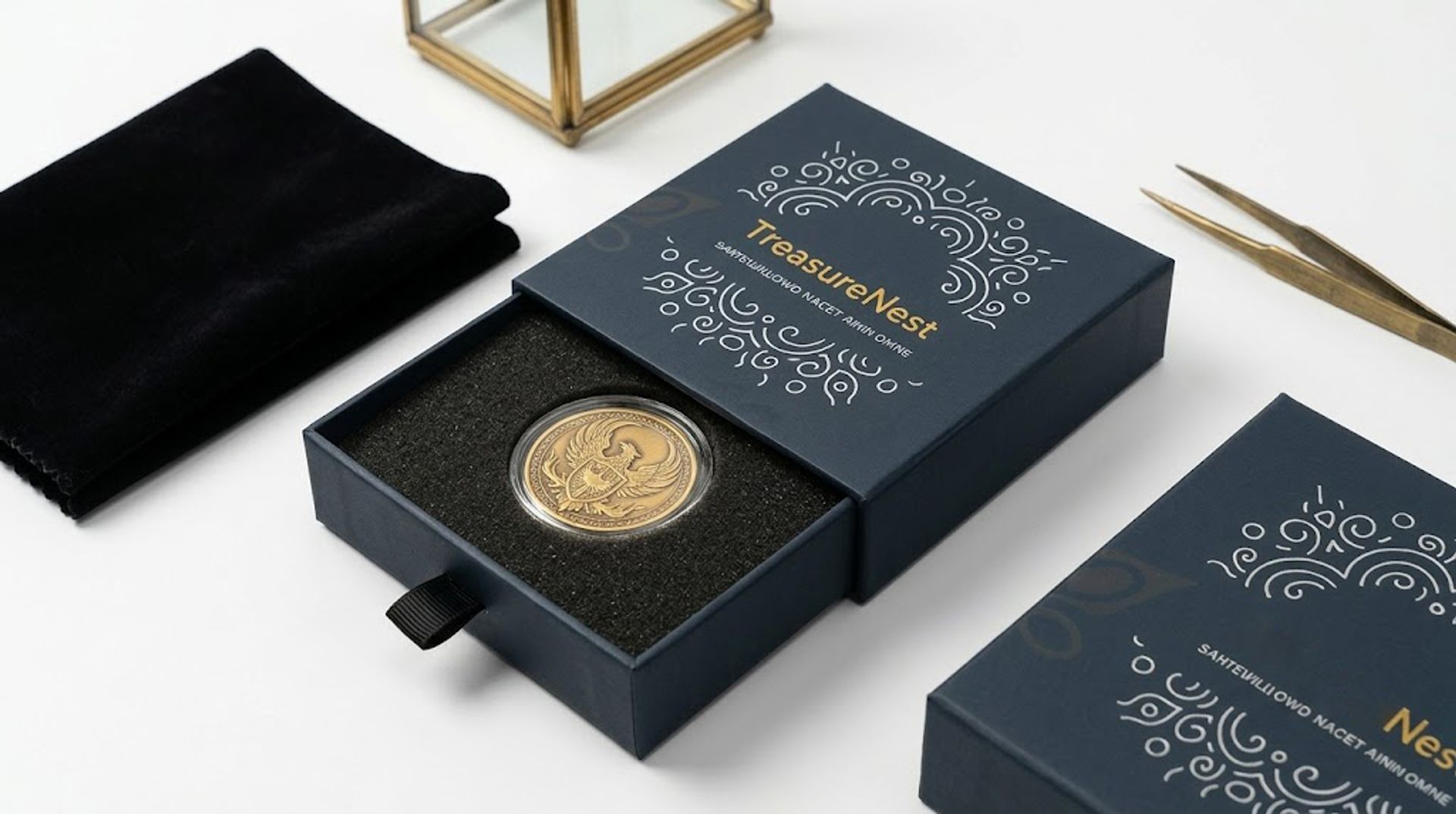
Coin box construction is mostly a stack of decisions about board, wrap, liner, and finishing. The coin itself is small and consistent; the box around it is where the brand, program tone, and presentation moment are built. A buyer who understands the coin box materials and finish options sends a tighter spec, gets a faster quote, and ends up with a box that matches the program.
This guide walks through the main material and finish options used in custom coin boxes, what each one tends to suit, and what to clarify during quoting.
Who Spec-Owns the Material and Finish Choice
Material and finish decisions usually sit with one of these buyer roles:
Program managers running recognition and award programs across military, public service, and corporate contexts
Brand and marketing teams producing commemorative and milestone coins where the box carries the brand
Procurement officers sourcing presentation packaging across multiple programs or units
Mint and coin manufacturer packaging leads spec'ing the box that ships with the coin to end clients
Numismatic dealers and collector retailers packaging individual coins or curated sets for resale
Event planners sourcing commemorative coin packaging for conferences, anniversaries, and milestone events
The pattern across buyer roles: most material and finish decisions are made by the person closest to the program, not the person placing the order. Get the program owner in the conversation early.
Rigid Board Construction
Rigid coin boxes use a chipboard base wrapped in a printed or specialty paper. Chipboard thickness commonly runs in the heavier weight ranges to support the box structure and the weight of the coin and any insert. The wrap is what carries the visual identity: full-color offset litho printing, specialty textured paper, wood-grain or leather-look paper, or solid color stock with foil or emboss treatment.
Rigid construction is the standard for individual coin presentation because the substantial feel matches the weight of the recognition moment. Lift-off lid, hinged lid, and magnetic-closure variants are all built on the same rigid chipboard frame with different lid mechanics.
Paperboard Tuck-End Construction
For volume programs and event giveaways, paperboard tuck-end coin boxes are a lower-cost alternative. Common substrates include SBS (solid bleached sulfate) for full-color printed exteriors, kraft for a natural unbleached look, and CCNB or CRB for cost-efficient runs. Paperboard tuck-end boxes are commonly used for fraternal and event programs, retail collector sets, and any context where rigid construction is not required.
Paperboard tuck-end coin boxes typically use a paperboard insert with a die-cut coin slot, a foam pad with a die-cut cavity, or no insert at all (coin loose in the box). Match the insert to whether the coin is meant to be carried, presented, or displayed.
Interior Liner Options
The interior liner is what holds the coin and carries the visual reveal at opening. Common liner options:
Velvet-flocked foam: the standard for upscale presentation. The flocked surface reads as polished, and the foam holds the coin firmly in a die-cut cavity. Common colors include navy, black, burgundy, cream, and olive.
Plain foam with die-cut cavity: a cost-efficient alternative for volume programs. The cavity holds the coin firmly without the flocked finish.
Satin or felt lining: alternative interior finishes for specific aesthetic positioning, often paired with hinged-lid display boxes.
Paperboard insert with coin slot: a lighter-weight option for event coins and fraternal programs.
Acrylic capsule with foam cradle: a clear protective capsule set into a foam cradle, common for collector and numismatic packaging where long-term coin protection matters.
Browse the custom rigid boxes listing for the rigid construction range, the custom paperboard boxes style listing for tuck-end formats, and the custom coin boxes page for coin-specific format guidance. Related upscale formats sit in the link to the custom gift boxes.
Exterior Printing
Coin box exteriors are commonly printed using offset litho for full-color brand artwork on rigid wrap or paperboard, with digital printing as an alternative for shorter runs and variable-data programs. The print decision depends on the run length, the artwork complexity, and whether per-recipient personalization is required.
For specialty wraps (wood-grain, leather-look, textured stock), the exterior is often left mostly unprinted with the brand or program identity carried by a foil-stamped or embossed mark. This is the convention for heritage and commemorative programs that lean understated.
Foil Stamping
Foil stamping is the most common upscale finishing for coin box exteriors. Common foil colors include gold, silver, copper, brass, and matte black. The foil is applied with heat and pressure to specific artwork areas (typically the program emblem, the brand mark, or a date range) rather than across the entire exterior.
Foil stamping pairs well with matte or textured exteriors because the foil reads cleanly against an understated background. Heritage and commemorative programs tend to lean toward matte exterior with a single foil-stamped emblem on the lid; corporate gifting programs sometimes layer foil with embossing for a tactile finish.
Embossing and Debossing
Embossing raises the artwork above the surface; debossing presses it below. Both are common on coin box lids for the program emblem, the brand mark, or a commemorative date. Embossing reads more prominently and is typical for heritage programs; debossing is more subtle and tends to pair with corporate brand marks where understatement fits the brand voice.
Embossing and debossing can be combined with foil stamping (foil-embossed mark) or applied alone (blind emboss or blind deboss). The decision depends on the program tone and the substrate's response to the embossing die.
Lamination, Spot UV, and Edge Treatments
For paperboard tuck-end coin boxes and printed rigid wraps, lamination protects the printed surface and shapes the tactile finish. Common lamination options include gloss for a polished read, matte for an understated read, and soft-touch for a velvet-like tactile finish that suits corporate gifting.
Spot UV applies a high-gloss varnish to specific artwork areas (brand mark, accent details) over a matte or soft-touch base for tactile contrast. Edge treatments on rigid box lids — painted edges, foil edges, or contrasting wrap colors — are common upscale touches for commemorative and milestone programs.
Common Mistakes Buyers Make on Coin Box Materials and Finish
Treating foil as a default rather than a deliberate choice: foil works best when applied to specific artwork areas, not as a wholesale exterior finish. Pick the mark that carries the program identity and foil-stamp that one element.
Mismatching liner color to exterior: a navy exterior with a bright red velvet liner reads as inconsistent. Match the liner palette to the exterior wrap or to the program color scheme.
Sizing the cavity to a generic coin spec: coin dimensions vary across mints. Send the actual coin diameter, thickness, and edge style during quoting so the cavity is sized to the specific coin.
Stacking too many finishing techniques: foil plus emboss plus spot UV plus edge paint can read as overworked. Pick the one or two techniques that match the program tone.
Skipping the lamination call: an unlaminated printed paperboard exterior may scuff in transit. Confirm whether lamination is included during quoting.
Specifying recycled or FSC stock without confirming availability: recycled-content and FSC-certified stock are generally available depending on the substrate, the run volume, and the supplier roster at the time of order. Confirm during quoting rather than assuming.
Order Custom Coin Boxes
Send the coin diameter and depth, insert type (foam, paperboard, velvet), single or set, finishing (foil, embossing), gift or commemorative context, and target quantity to The Printing World. Our team will review the details and provide quote and proofing guidance after the specifications are confirmed. Reach us through sales@theprintingworld.com, +1 (888) 883-6313.
Standard production runs 10–14 business days after artwork approval. Specialty finishing (multi-stage foil, combined emboss-and-foil, custom edge treatments) is supported within the standard production window when the techniques are confirmed at quoting.
Need custom packaging for your product?
Get pricing, samples, and expert advice — no commitment required.
Industries