
Custom Food Trays: Styles, Sizes & Greaseproof Materials
Custom food trays have to keep a hot or saucy portion flat and visible while carrying your brand from the counter to the customer. This guide covers who orders food trays, the open-tray, boat, and divided styles that fit each service model, how to size the portion, and the material, greaseproof, and printing choices that decide how the tray performs.

Awais M · Custom Packaging Specialist
Awais M helps small and mid-sized brands get custom packaging right — the box style, the material, the print finish, and the order quantity that actually fits the budget.
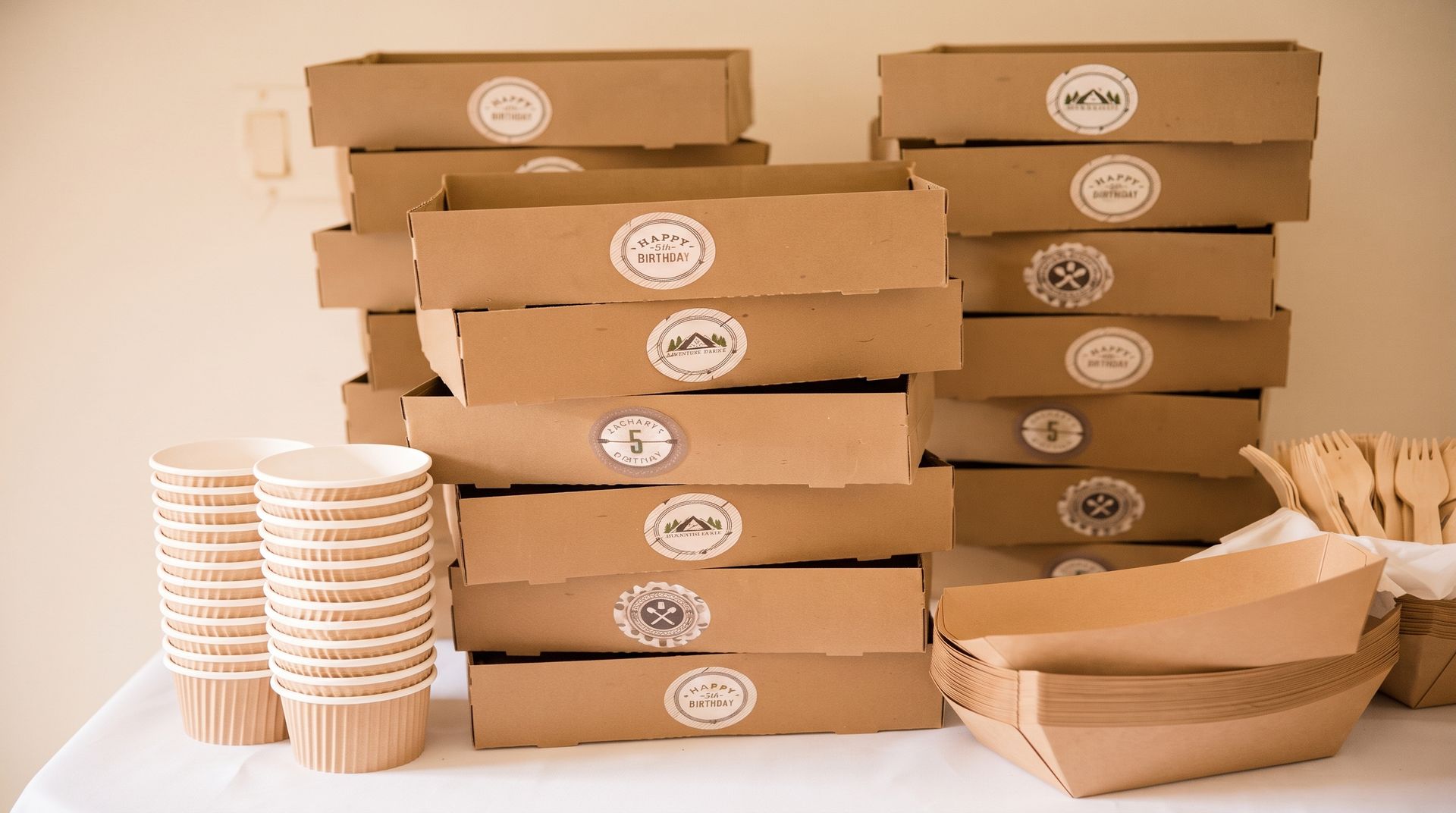
Custom food trays are the open paperboard trays that carry a served portion from the kitchen or fryer to the customer's hand. Food moves fast, it often moves hot, and it can move oily or saucy, so the tray has to hold the portion flat, let a little steam off, and carry the brand at the same time. This guide walks through who orders custom food trays, the tray styles that fit different service models, how to size the portion, and the material and printing choices that decide how the tray performs.
Done right, a printed food tray does two jobs at once. It keeps the portion flat and contained from the counter to the customer, and it puts your logo in front of the customer for the length of the meal. Done wrong, it goes soft under an oily portion, lets the food slide around, or buckles under a loaded build. The difference is mostly in the spec.
Who Orders Custom Food Trays
Food tray packaging is ordered across the whole quick-service and event-catering world, not just one type of operator:
Concession stands and snack bars: wide share trays for fries, nachos, and fair-food portions that fill fast and hand off in seconds.
Food trucks and street vendors: compact boats and open trays that plate a portion at the window with the brand facing out.
Quick-service and fast-casual kitchens: divided compartment trays for combos that keep the main and the sides separated.
Bakeries and delis: open trays and boats for grab-and-go counter portions and prepared sides.
Caterers and event programs: printed serving trays for buffets, grazing stations, and boxed-event service.
Sports venues, cinemas, and fairs: large share trays for high-volume snack runs.
Meal-kit and prepared-meal brands: divided trays that portion a finished meal for pickup or a short delivery trip.
Ghost kitchens and delivery brands: deeper trays with a lid or sleeve that hold the portion through a courier handoff.
If you are comparing printed food trays against plain stock, the branded version is what turns a snack portion into a brand impression every time the tray hits the table.
Tray Styles for Food Service
Food trays run across a handful of core structures. The right one depends on how the order is served and whether it travels:
Open serving tray: the everyday workhorse, a flat-bottom tray with low flared walls for counter, walk-up, and dine-in service.
Food boat: a curved-end open tray that cradles a handheld portion such as fries or a fair-food snack.
Divided compartment tray: a tray split into two or three sections so a combo or sampler keeps its items separate.
Auto-lock or tuck-corner tray: a tray with locking corners that gives the base extra rigidity for heavier or wetter portions.
Deep-walled scoop tray: a taller-walled tray that holds a loaded or saucier portion without spilling over the rim.
Tray with separate lid or sleeve: an open tray paired with a board lid or wrap sleeve when the portion is covered for transport or display.
Open trays and boats ship flat and set up on the line, while auto-lock and deep-walled trays add structure for transit. Browse the full range on the food boxes listing to compare formats side by side.
Choosing the Right Size
Food tray sizes scale with the portion, not a single industry standard. A small boat suits a side or single snack, a medium open tray suits a standard entree portion, and a large share tray suits a group or a loaded build. The wall height and footprint are set to the portion and how it is carried, so a walk-up tray is sized to hand off comfortably while a delivery tray is sized to sit flat in the bag.
The goal is food that sits flat and stays visible without spilling over the wall. A tray that is too large lets the portion slide, and one packed too tight crushes the food and traps steam. Match the footprint to the portion in ounces or grams and the way the tray is carried.
Send your portion weight, serving style (counter, walk-up, or delivery), tray or boat preference, divided-compartment requirement, and target quantity, and we will recommend the size range and structure.
Materials and Greaseproof Options
Food trays are built on a board chosen for look, print quality, and oil and moisture exposure:
Kraft paperboard: a casual brown board, commonly in a 16 to 24 pt range, good for one- or two-color printing at a lower cost.
SBS (solid bleached sulfate): a bright white board for full-color, photo-forward art.
Coated or greaseproof-lined board: a coating or inner greaseproof paper liner for hot, oily, or saucy portions.
Grease resistance depends on the coating or liner, the oil and moisture content of the food, and how long the portion sits, so a heavily loaded portion is matched to a coated board or greaseproof liner rather than assumed to hold on plain stock. A coated surface may help with light surface protection depending on the coating, liner, food type, and contact duration. The substrate should be appropriate for the intended food-contact application, so confirm food-contact requirements during quoting. See the material catalog for the full substrate range.
Printing and Branding
Food trays print across the open surface, and the format rewards bold, appetizing art. Full-color printing carries brand color and food photography on SBS or coated board, while one- or two-color printing keeps a clean logo on kraft at a lower cost. Matte or gloss coatings keep the artwork crisp, and an aqueous coat adds light scuff resistance to the printed face. Finishes are chosen for the look rather than required on every tray. Compare the options on the finishes page, and see related formats: burger boxes, sushi boxes, or tofu boxes listing.
Common Mistakes to Avoid
Sizing to the tray instead of the portion: a generic tray can drown a small portion or crush a large one — size to the food weight and serving style.
Assuming plain board resists grease: uncoated stock may soak through with hot, oily portions; match a coated board or greaseproof liner to the oil exposure.
Choosing a flat tray for a saucy portion: a low wall lets sauce run over the edge; consider a deep-walled or auto-lock tray when the build is wet.
Ignoring carrier and bag fit: a tray that will not sit flat in a delivery bag or stack on a carrier creates handling problems — confirm the footprint.
Printing dark art on uncoated kraft and expecting photo punch: kraft tends to mute color, so reserve photo-forward art for white SBS or coated board.
Treating food-contact suitability as a given: confirm the coating or liner is food-contact-appropriate for the intended use during quoting rather than after the run.
Order Custom Food Trays
Tell us your portion sizes, serving style, tray or boat choice, divided-compartment requirement, substrate, grease handling need, branding, and target quantity, and we will spec the tray and quote it. Standard production runs 10 to 14 business days after artwork approval. Reorders on locked artwork may reduce proofing time because the structure and artwork are already approved, but standard production remains 10–14 business days after artwork approval unless otherwise confirmed. Contact The Printing World at sales@theprintingworld.com, or message us on WhatsApp at +16133831487.
Need custom packaging for your product?
Get pricing, samples, and expert advice — no commitment required.