
Custom Velvet Boxes: A Practical Packaging Guide
A velvet box is a rigid shell wrapped in a soft, flocked surface, so it has to hold the jewelry still and present it cleanly at the open. This guide covers who orders velvet packaging, the main box styles, how flocked inserts grip a ring or chain, how sizing works from the piece, and the material and finishing choices.

Awais M · Custom Packaging Specialist
Awais M helps small and mid-sized brands get custom packaging right — the box style, the material, the print finish, and the order quantity that actually fits the budget.
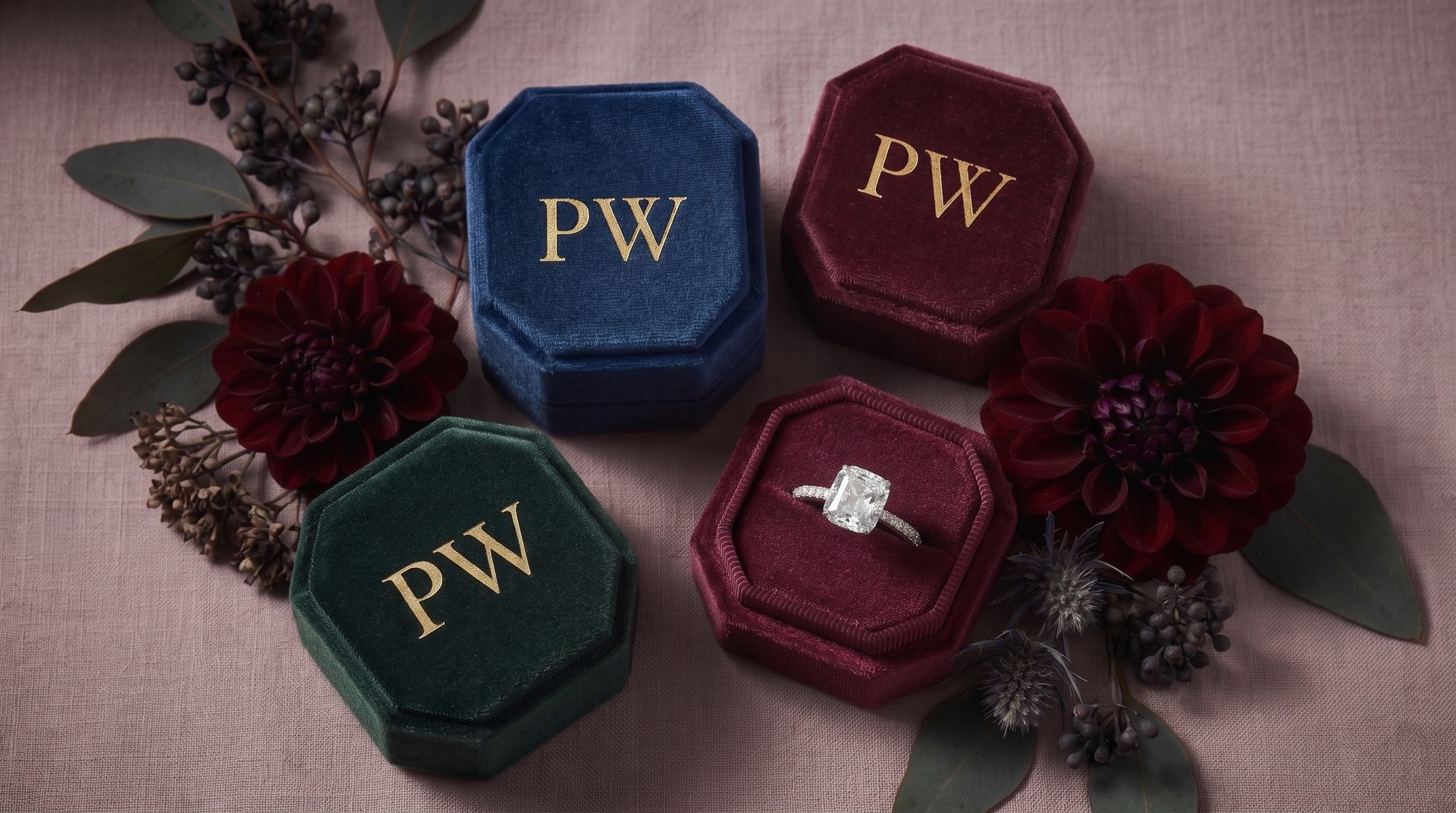
Opening a ring case only to find synthetic velvet lint clinging to diamond prongs, yellow glue stains bleeding through thin fabric corners, and bald rub marks across the lid ruins the value of fine jewelry and collector watches. Retailers, medal makers, and fragrance brands face three recurring manufacturing defects when ordering fabric-wrapped jewelry boxes: low-density pile crushing permanently under warehouse stacking weight, acidic animal glues off-gassing sulfur that tarnishes sterling silver, and hot foil logos flaking off uneven fabric nap. Solving these presentation failures requires custom velvet boxes engineered with high-density short-pile textiles, moisture-cured neutral adhesives, and deep-relief brass stamping dies.
Dimensional Blueprints: Matching Box Size to Jewelry and Keepsakes
Because velvet fabric and interior satin pads add 1.5 mm to 3.0 mm of wall thickness around every inner edge, external box dimensions do not equal usable internal space. Measure the physical item plus your foam insert margin, then add 0.15 inches to the outer footprint to compensate for the wrapped fabric fold-over:
Item Format | Typical Product Profile | Standard Box Dimensions (L x W x H) | Internal Insert Configuration |
Solitaire Ring / Stud Box | Single Band or Ear Studs | 2.0 x 2.0 x 1.75 in | High-density slotted EVA foam + velvet wrap |
Double Ring Ceremony Case | Two Wedding Bands | 2.75 x 2.25 x 1.75 in | Dual parallel compression slots + satin lid puff |
Pendant & Drop Earring Box | Charm + 18 in Chain | 3.0 x 3.0 x 1.50 in | Angled collar card with two top chain notches |
Bangle / Chrono Watch Case | Cuff Bracelet or Timepiece | 4.0 x 4.0 x 2.75 in | Removable C-clip cuff or compressible velvet pillow |
Flat-Lay Necklace Presentation | Collar / Statement Chain | 8.5 x 2.5 x 1.25 in | Padded velvet bed with dual elastic clasp hooks |
Commemorative Medal / Coin | 2.0 in – 2.5 in Struck Disc | 3.75 x 3.75 x 1.25 in | Recessed circular die-cut well + finger lift notch |
Exterior Box Shape and Hinge Mechanics
Velvet adds friction along sliding surfaces, meaning traditional paperboard tolerances will bind or jam if applied directly to fabric-wrapped cases. Selecting the right shape for your custom velvet boxes accounts for fabric thickness and opening torque:
Spring-Hinged Clamshell Cases: Built with a concealed steel spring hinge joining two molded shells. The spring snaps the lid shut firmly without an exterior latch and holds the top cover upright at a 95-degree display angle under boutique showcase lights.
Double-Door (French Door) Presentation Boxes: Split the top lid down the center into two outward-swinging doors that meet at a central metal clasp or ribbon tie. This theatrical reveal shape works well for wide bridal parure sets, heavy signet rings, and ceremonial awards.
Vintage Octagonal and Dome-Top Ring Boxes: Feature faceted eight-sided walls or a rounded barrel lid that minimizes flat surface contact inside outer shipping cartons, reducing the risk of flattened velvet pile during transit.
Two-Piece Telescopic Setup Boxes with Step Shoulders: Because velvet-on-velvet friction makes full-depth slip lids hard to pull apart, adding a stepped inner neck (shoulder) reduces the contact zone to a narrow 0.25-inch rim, allowing the lid to lift off smoothly.
Drawer-Style Slide Boxes with Satin Pulls: Pairs a rigid velvet-wrapped outer sleeve with a smooth paperboard or satin-lined inner drawer. Using contrasting smooth paper on the sliding runner tracks prevents the velvet nap from catching and tearing.
Core Material Selection: Base Shells and Pile Chemistry
Not all "velvet" used in packaging is woven fabric; manufacturers use two distinct textile systems over two different core substrates depending on budget and durability requirements:
Injection-Molded Polystyrene (PS) Cores vs. Rigid Grayboard: High-volume spring-hinged ring boxes use 2.0 mm injection-molded plastic shells that allow curved domes and thin walls without warping. Conversely, flat-edged necklace chests and drawer boxes use 1200 GSM to 1500 GSM sulfur-free, neutral-pH rigid paperboard cores that resist cracking during courier drops.
Woven Rayon/Silk Velvet vs. Electrostatic Flocked Velvet: True woven velvet features dense vertical yarn loops woven into a cloth backing (220 GSM to 300 GSM), offering deep light absorption and zero fiber shedding. Electrostatic flocked paper or fabric shoots short nylon fibers onto an adhesive backing; it costs less for promotional runs but sheds lint if bent sharply along 90-degree corners.
Anti-Tarnish Adhesive Chemistry: Standard water-based animal glues and acidic polyvinyl acetate (PVA) pastes turn yellow and release sulfur gases that blacken sterling silver jewelry inside closed packaging boxes. Specify neutral-pH, sulfur-free synthetic resin adhesives tested to keep reducible sulfur below 0.0008%.
Printing Precision on Deep-Pile Surfaces
Standard liquid offset or screen inks sink straight into velvet fibers like a sponge, creating blurry, unreadable blobs. Applying sharp typography onto custom boxes requires heat, pressure, or solid carrier plates to bridge the fabric nap:
Deep-Relief Brass Die Hot Foil Stamping: Standard thin magnesium foil plates fail on velvet because the surrounding plush fibers swallow the shallow stamp. Using a deeply engraved brass die heated to 230°F–260°F melts and flattens the microscopic velvet pile first, bonding metallic gold, rose gold, or silver foil cleanly into the recessed trough.
Inside-Lid Satin Puff Printing: To avoid stamping rough exterior pile altogether, mount a pleated white or black satin fabric puff inside the top lid. Smooth satin accepts razor-sharp metallic foil stamping and high-resolution screen printing for fine serif monograms and crests.
3D Metal Emblem & Acrylic Nameplate Mounting: For intricate multi-color coats of arms or ultra-thin luxury watch logos, die-cast a thin zinc-alloy or brushed brass metal plate. The plate is seated into a pre-debossed cavity on the velvet lid using industrial 3M thermal tape so the metal sits flush with the surrounding fabric pile.
Protective Surface Finish and Anti-Crush Transit Defense
Velvet's upright fiber nap acts like a magnet for airborne cardboard dust and suffers permanent "crush marks" if pressed directly against rough corrugated walls in transit. Pairing a protective textile finish with outer barrier sleeves keeps every box showroom-ready:
Fluorocarbon-Free Water and Oil Repellent Treatment: Treating the woven velvet roll with a cross-linked hydrophobic textile finish stops skin oils, bridal hand lotion, and retail counter moisture from matting down the pile or leaving dark stains on pastel pink, ivory, or champagne fabrics.
Anti-Static Brushing and Lint Sealing: Passing finished boxes through an ionized air knife and heated roller seals loose cut-edge fibers along the inner rim so zero stray threads transfer onto diamond prongs or watch crystals.
Two-Piece Protective Outer Paperboard Packers: Never pack bare velvet cases directly into corrugated master cartons. Enclose each velvet box inside a snug 300 GSM white or kraft paperboard two-piece packer box (or a non-woven polypropylene dust bag) to block cardboard dust and prevent pressure spots on the velvet nap during international freight.
Order Custom Velvet Boxes
To get a tight quote, send the jewelry type and piece dimensions, the pieces per box, the velvet color, the construction (clamshell, lid-off, drawer, magnetic, book-style, or pillow), the branding and finishing direction, and your target quantity to The Printing World. Our team will review the details and provide a quote and proofing guidance once the specifications are confirmed. Reach us at sales@theprintingworld.com, or +16133831487.
Reorders on locked artwork may reduce proofing time because the structure and artwork are already approved, but standard production remains 10–14 business days after artwork approval unless otherwise confirmed.
Need custom packaging for your product?
Get pricing, samples, and expert advice — no commitment required.